
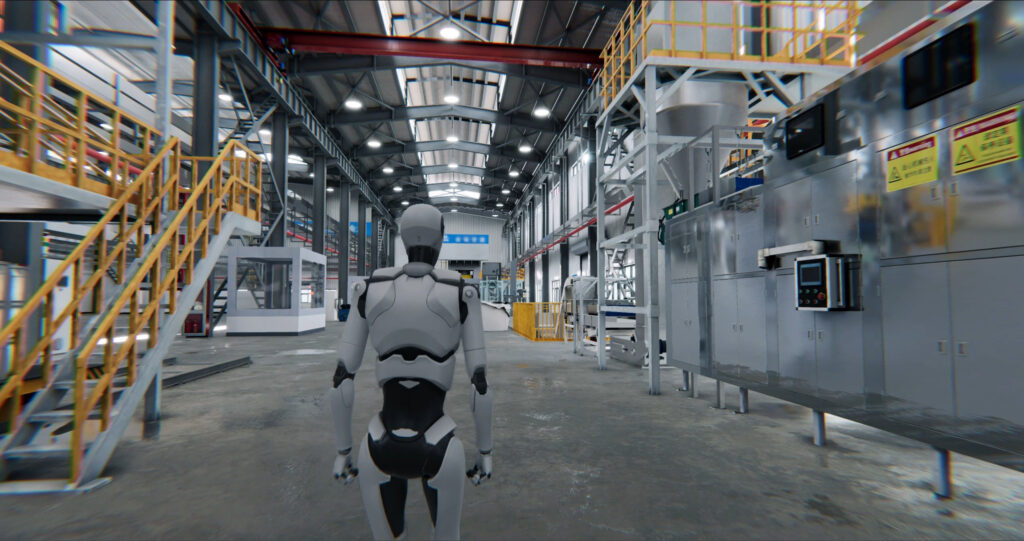
In recent years, digital twin initiatives have expanded rapidly across industries. At the same time, emerging technologies such as Physical AI and embodied intelligence are gaining momentum.
In this context, NVIDIA has introduced the concept of SimReady—a standard and ecosystem aimed at enabling simulation-ready digital environments.
As enterprises begin to explore Physical AI in real-world scenarios, a fundamental question is emerging:
What kind of digital assets are truly ready for this next phase of industrial intelligence?
Why Traditional 3D Assets Fall Short
Many industrial organizations have already developed extensive digital assets, including CAD models, BIM data, and 3D representations of factories and production environments.
As use cases evolve toward:
- production simulation
- robot training
- logistics optimization
- safety validation
- AI-driven operations
a clear limitation becomes apparent:
- a model that looks realistic does not necessarily support simulation
- a complete 3D scene does not automatically translate into an operational environment
Traditional 3D models are built for visualization—not computation.
As industrial systems move into the AI era, digital assets must go beyond visual representation. They need to become computable, verifiable, and reusable simulation objects.
What Defines a SimReady Asset
SimReady Assets extend digital assets from static models into simulation-ready industrial objects.
Unlike traditional 3D models, which focus primarily on geometry and rendering, SimReady Assets incorporate:
- physical accuracy — real-world scale, collision, mass, friction, and constraints
- structural consistency — aligned coordinates, orientation, and hierarchy
- semantic information — equipment types, functional zones, and relationships
- behavior logic — how assets operate, respond, and transition between states
- data connectivity — integration with sensors, PLCs, MES, and operational systems
These capabilities determine whether an asset can simply be viewed, or whether it can be simulated, validated, and used in AI workflows.
This distinction marks a critical step in the evolution of digital twins—from visualization systems to simulation environments.
At the same time, fragmented industrial software formats have made it difficult to reuse assets across systems. DataMesh is working with NVIDIA to evolve the SimReady standard, helping unify assets within OpenUSD and break down current simulation barriers.
Why Behavior Logic Is Essential
In industrial environments, physical properties alone are not sufficient.
Operations are governed not only by physics, but also by:
- process logic
- control systems
- safety requirements
- operational workflows
A machine does not simply exist—it operates within a set of rules and conditions.
To capture this, SimReady Assets incorporate behavior logic.
In DataMesh FactVerse, this is implemented through Behavior Trees, which define how assets respond to different conditions, transition between states, and interact with other systems.
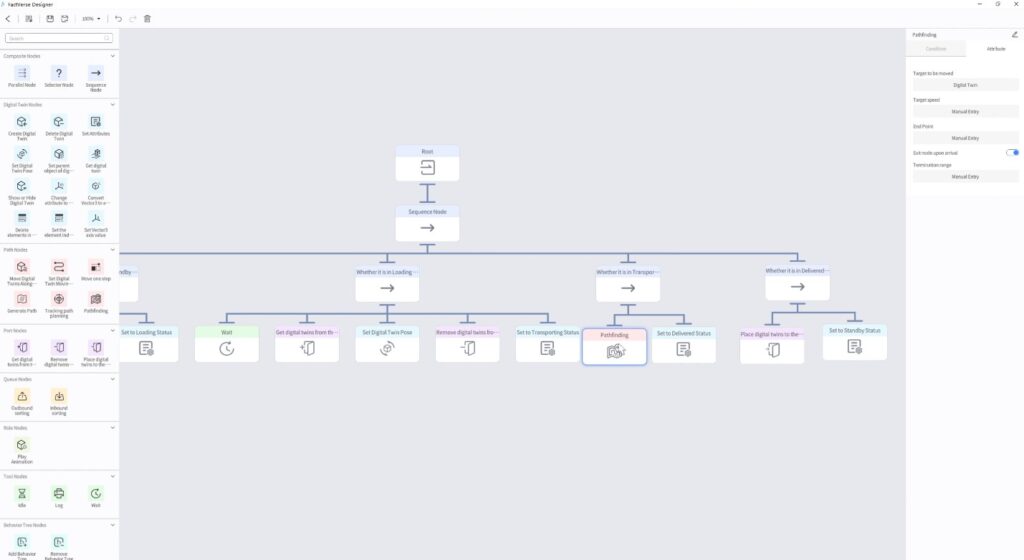
For example, a digital representation of a machine can include:
- basic attributes (model, size, location)
- operational status (cycle time, throughput, energy consumption)
- data connections (PLC, sensors, MES)
- physical constraints (collision, boundaries, safety distances)
- behavior logic (start, stop, fault, recovery, interlocks)
- interaction rules (responses to personnel, robots, and material flow)
With these elements, the asset becomes more than a model—it becomes a functional digital object that can participate in simulation, training, and execution.
Enabling Physical AI and Robotics
Physical AI systems require more than visual data. They depend on high-quality digital environments that reflect how the real world operates.
Such environments must capture:
- spatial relationships
- physical constraints
- process flows
- operational logic
This has a direct impact on AI performance:
- with conventional 3D assets, AI interacts with environments that only look realistic
- with SimReady Assets, AI interacts with environments that behave like real systems
This difference is critical for:
- robot training and deployment
- simulation accuracy
- risk validation and scenario testing
SimReady Assets provide the foundation for building reliable, executable digital environments for Physical AI.
Toward SimReady Asset Libraries
As industrial use cases evolve, so does the role of digital asset management.
Traditional asset libraries—focused on CAD files or 3D models—are no longer sufficient.
Leading organizations are moving toward SimReady Asset Libraries, where assets are:
- structured as industrial objects
- enriched with behavior and physical properties
- designed for reuse across scenarios
In this context:
- a machine becomes a production unit with logic, state, and constraints
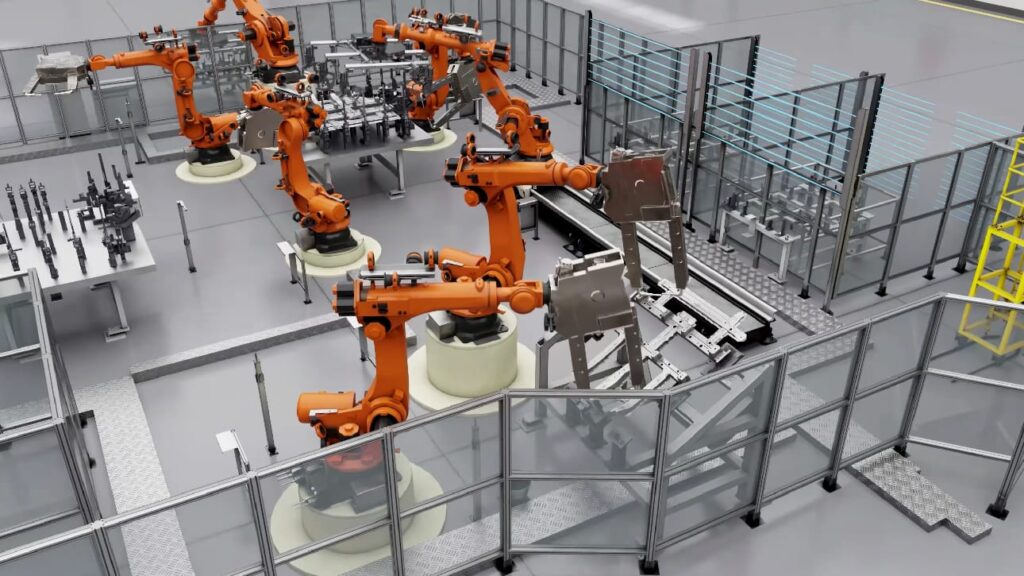
- a robotic cell becomes a simulation system with safety and coordination rules
- a conveyor becomes a dynamic process component with speed and flow logic
- a factory becomes an operational digital environment with people, machines, and rules
These assets can be reused across applications such as planning, training, simulation, optimization, and AI development.
This is how you scale industrial intelligence.
DataMesh in Practice
DataMesh is working with leading global manufacturers to validate SimReady Assets in real production environments.
In these scenarios, SimReady Assets are being applied to improve process efficiency, support simulation-based validation, and enable new Physical AI use cases across production lines.
From a long-term perspective, the goal is to transform equipment, spaces, processes, workflows, personnel, and materials into a system of configurable, simulatable, and verifiable digital assets.
These assets must:
- function as industrial objects, not isolated models
- capture behavior, not just appearance
- represent real physical relationships
- work seamlessly with AI systems
This shift moves beyond one-time 3D modeling projects toward a continuously evolving and reusable digital asset system.
An Evolving Industry Direction
Recently, the NVIDIA Omniverse team visited DataMesh to exchange perspectives on topics such as Omniverse, Physical AI, and SimReady Assets.
As digital twins evolve—from visualization to simulation, and from human-machine interaction to AI-driven collaboration—it is becoming increasingly clear that SimReady Assets are not simply a new type of digital asset, but a foundational layer for industrial digital systems in the Physical AI era.
As Physical AI continues to mature, competitive advantage will increasingly depend on the ability to translate the real world into digital environments that AI can understand, simulations can execute, and operations can scale.
At DataMesh, we are helping enterprises build this next generation of industrial digital infrastructure—powered by SimReady Assets.
Whether you are exploring digital twins, robotics, or AI-driven operations, the journey starts here.