Built For
Semiconductor fabs, energy systems, manufacturing plants, aviation MRO, logistics facilities, and other complex sites building Physical AI operations.
Executable Physical AI
Dual-Engine Platform for Physical AI and Executable Digital Twins
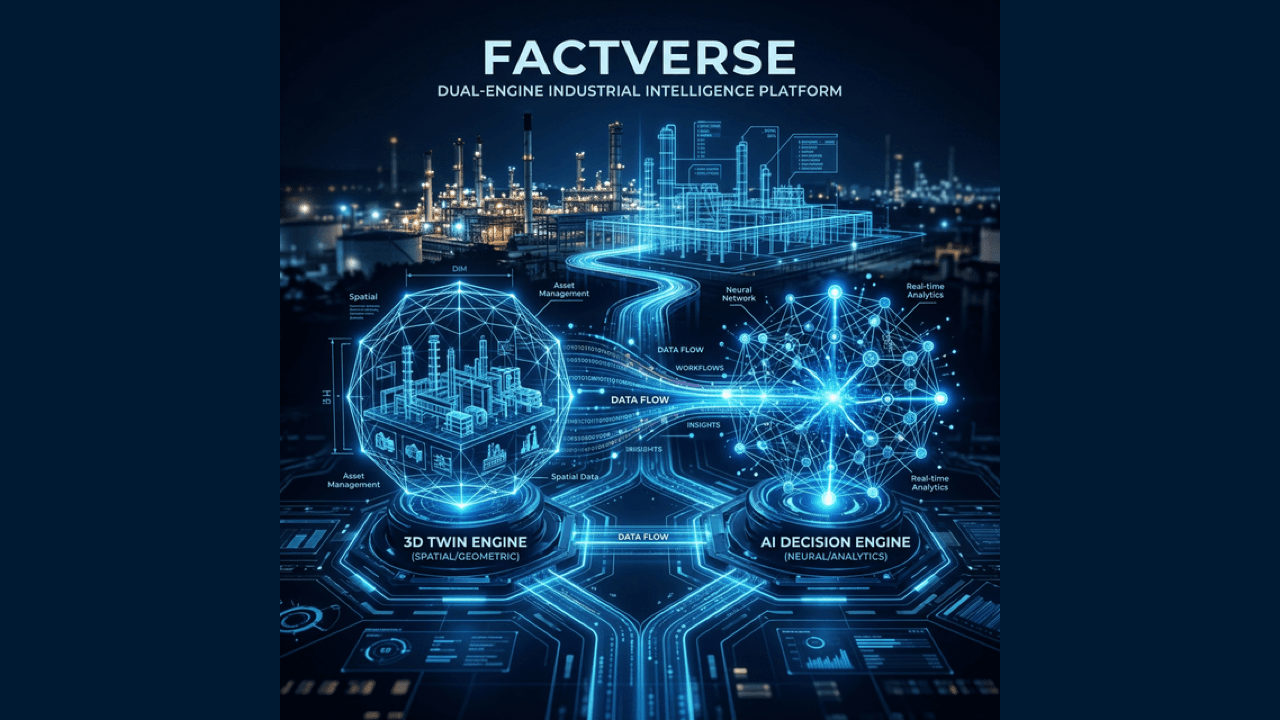
The dual-engine Physical AI platform from DataMesh. FactVerse combines a 3D twin execution engine with an AI decision engine so complex facilities can connect data, validate actions, and move from analysis to executable operations.
Connected data
Bring plant systems, enterprise records, and documents into one model.
Twin execution
Validate decisions in the operational 3D environment before release.
Physical AI decisions
Run what-if analysis and next-best-action workflows with real-world context.
Built For
Semiconductor fabs, energy systems, manufacturing plants, aviation MRO, logistics facilities, and other complex sites building Physical AI operations.
Deployment
Deploy in cloud, private, or hybrid environments while keeping data access and operational boundaries under control.
Engine One
Twin Engine turns geometry, assets, telemetry, and workflows into an operational runtime. It is the environment where teams can visualize systems, validate Physical AI decisions, and deliver executable digital twin applications.
Engine Two
AI Agent turns operational questions into what-if analysis, scenario comparison, and recommendations. It gives FactVerse a Physical AI decision layer that can still be checked against the real facility before action.
Executable Twin
A visualization twin helps teams see assets and spaces. An executable twin connects geometry, live data, operating rules, simulation, and work orders so decisions can be tested, approved, and carried into field execution.
See
Show asset location, status, and spatial context so teams share the same operating picture.
Test
Run scenario checks, AI recommendations, and workflow logic against the current state of the site.
Act
Send approved actions into Inspector, Checklist, Simulator, or enterprise systems with traceable records.
Physical AI, world models, and embodied intelligence need to understand how a real factory operates. Visual appearance and dashboard signals are only the entry point; AI and robots also need asset semantics, spatial relationships, process steps, equipment state, safety boundaries, work-order history, and simulation results. An executable digital twin organizes that context into a computable, verifiable, and traceable site model, so the factory brain can use real operating constraints when recommending actions, training robots, or testing scenarios instead of judging only from images and dashboards.
Core Capabilities
FactVerse combines data connectivity, twin runtime, AI decision support, and frontline applications in one operational system for Physical AI.
How It Works
Step 01
Use Data Fusion Services to connect plant data, enterprise records, documents, and operational signals into one platform context.
Step 02
Use Twin Engine and Designer to model scenes, assets, relationships, and executable workflows.
Step 03
Use AI Agent to ask questions, compare scenarios, and generate recommendations across complex operations.
Step 04
Check recommendations in the twin, then deliver them through applications and frontline workflows.
Overview
FactVerse is no longer best described as a single digital twin engine. It is the full operating platform that connects data access, scene execution, AI reasoning, and application delivery for complex Physical AI environments.
That shift matters because most facilities do not struggle with one missing tool. They struggle with disconnected layers: data in one place, geometry in another, workflows in another, and decision support somewhere else. FactVerse brings those layers together under one architecture.

Overview
The center of the platform is a dual-engine model:
Together they move teams from "what happened" to "what should we do next" and then to "can this really work in the physical environment?"

Overview
Twin Engine is the part of FactVerse that understands the physical world. It binds 3D scenes, asset relationships, process logic, and real-time signals into an executable runtime. That gives the platform a place where plans can be visualized, checked, and turned into guided operational experiences.
This is why Twin Engine is more than a viewer. It is the environment where maintenance, inspections, simulations, training, and operational validation can all run against the same facility model.

Overview
AI Agent is the part of FactVerse that helps teams decide. It supports natural language interactions, what-if analysis, optimization, forecasting, anomaly detection, and other decision workflows that are difficult to manage through dashboards alone.
Instead of stopping at an answer, AI Agent hands the recommendation back into the FactVerse environment so it can be reviewed against spatial and operational constraints before action is taken.
Deployment
FactVerse also includes the layers that make the two engines practical in real deployments:
FactVerse is the platform umbrella. Twin Engine owns the executable spatial runtime. Data Fusion Services owns connectivity and data preparation. Designer owns scene authoring, process logic, virtual planning, and simulation workflows. AI Agent owns analysis, recommendations, and decision support. Inspector owns asset, inspection, work-order, and evidence workflows. Director owns guided SOP and training content. Simulator owns heavy equipment operator training.
Keeping those responsibilities separate makes the public story clearer: FactVerse connects the products into a Physical AI operating loop, but each product still has a specific role.
This is what turns FactVerse into a platform architecture.
The platform is designed to support a continuous loop:
That loop is what allows FactVerse to support the full decision-to-execution chain across visualization, analysis, and execution.
FactVerse is built for facilities where deployment choices matter as much as features. Some teams need a public cloud rollout. Others need private infrastructure, local data access, or hybrid connectivity between secure plant systems and shared authoring environments.
Because the platform spans data, simulation, AI, and operational interfaces, it can be introduced progressively: start with connectivity and twin visibility, add guided workflows, and then layer in AI-native decision support as teams are ready.
Use Cases
Give operations teams one platform for monitoring conditions, asking questions, running what-if scenarios, and validating the result inside the actual facility context.
Combine equipment health, real-time status, and spatial context so teams can decide what to service first, when to intervene, and how to execute the work with fewer surprises.
Build guided operations, inspections, training, planning, and optimization workflows on a shared twin and data foundation across applications.
FAQ
FactVerse is now the umbrella platform for DataMesh's dual-engine architecture. It combines Twin Engine for spatial execution and AI Agent for decision intelligence, supported by Data Fusion Services and Designer.
Industrial teams need a platform that can connect data, model the physical world, reason over decisions, and support execution across applications.
AI Agent analyzes questions, compares alternatives, and generates recommendations. Twin Engine provides the physical runtime where those recommendations can be checked against layout, assets, process dependencies, and operating limits before execution.
Visualization is one outcome, but the platform is designed for executable operations: inspections, maintenance planning, scenario analysis, training, optimization, and AI-guided decision workflows.
FactVerse supports cloud, private, and hybrid deployments so enterprises can match the platform to plant connectivity, cybersecurity, compliance, and regional rollout requirements.
Next Step
FactVerse helps industrial teams close the loop from data access to decision support, physical validation, and frontline execution.
Continue with the most relevant products, solutions, guides, and public references for this topic.