The missing layer is meaning
Industrial AI answers are only useful when the system knows what the question is about. A phrase such as "chiller 2," "line 4," "cleanroom humidity," or "the pump behind the alarm" has to resolve to a real asset, space, signal, document, and owner.
An industrial knowledge graph provides that semantic layer. It connects the objects in a site and records how they relate to each other. FactVerse uses this kind of model to make digital twin scenes, operational data, documents, and AI reasoning point to the same physical context.
What the graph models
The graph should describe the operating site in terms that engineers, operators, data systems, and AI agents can all use.
| Model area | Typical entities |
|---|---|
| Spatial structure | site, building, floor, room, zone, line, corridor, rack, bay, outdoor area |
| Physical assets | equipment, meters, sensors, valves, panels, pumps, robots, vehicles, tools |
| Systems | HVAC, chilled water, compressed air, power, process utility, safety, logistics flow |
| Data points | telemetry tags, alarms, calculated indicators, setpoints, status values |
| Knowledge objects | SOPs, manuals, drawings, BIM or CAD references, inspection templates |
| Events and records | alarms, inspections, maintenance events, approvals, handover records |
| Responsibility | owner, operator, service team, reviewer, risk class, permission boundary |
The model becomes useful when it can answer relationship questions across systems, records, and physical locations.
Relationship examples
Relationships are the core of the graph. They let AI and applications move from one record to the surrounding context.
| Relationship | Example question it supports |
|---|---|
| asset located in space | Where is the equipment behind this alarm? |
| equipment serves zone | Which areas are affected by this AHU? |
| point measures equipment | Which sensor produced this trend? |
| meter measures system | Which energy reading belongs to this chilled water loop? |
| equipment belongs to system | What upstream or downstream assets matter? |
| asset has procedure | Which SOP applies before inspection or maintenance? |
| event involves asset | Which alarms, inspections, and repairs belong to this object? |
| record approved by role | Who can review or release the next action? |
These relationships give the AI Agent a grounded path from question to evidence.
How FactVerse uses semantic context
Data Fusion Services maps source-system names, tags, documents, and records into a consistent model. The same pump, meter, room, or system may appear under different names in BMS, SCADA, CMMS, BIM, spreadsheets, and drawings. Semantic mapping gives those aliases one operational identity.
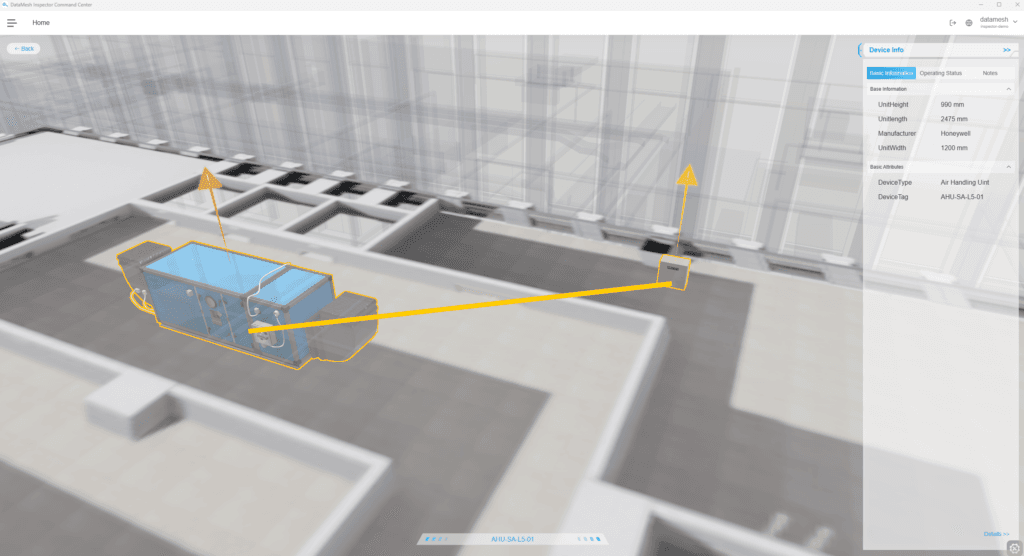
FactVerse Twin Engine connects that identity to the spatial model. A signal can appear on the right object in the 3D scene. A document can be attached to the correct asset. A system can be reviewed as a relationship network instead of a flat equipment list.
FactVerse AI Agent can then retrieve evidence through the graph. It can follow relationships from an alarm to the asset, from the asset to its system, from the system to its affected zones, and from those zones to relevant procedures or records.
Brick Schema and facility semantics
For buildings and facilities, Brick Schema is a useful public reference for modeling equipment, points, locations, meters, sensors, and relationships. It gives teams a shared vocabulary for questions such as which point measures a device, which equipment feeds a zone, or which meter belongs to a system.
DataMesh can align facility models with Brick-style semantics where it helps. A broader industrial site usually needs additional concepts: production lines, sub-fab systems, logistics areas, clean utility systems, warehouse zones, robotics cells, operator stations, and simulation assets. The practical goal is a semantic model that reflects the site, while still using standards where they reduce ambiguity.
Useful public Brick resources include:
AI grounding and explainable retrieval
Knowledge graphs help AI agents answer with traceable context. Instead of searching every document equally, the AI Agent can use the graph to narrow the evidence set.
For example, a facility engineer may ask why one zone has repeated humidity alarms. The graph can identify the zone, the sensors that measure it, the AHU that serves it, the chilled water assets connected to that AHU, recent alarms, related inspection records, and relevant SOPs. The AI Agent can then summarize evidence with clear references to the objects and records involved.
This approach also helps prevent misleading answers. When the graph cannot connect a signal to an asset, or a document to a valid procedure, the system can surface that gap instead of treating the data as reliable context.
Governance of the semantic model
A knowledge graph needs stewardship. Asset IDs, aliases, relationships, point mappings, and document links change as facilities are renovated, equipment is replaced, and systems are reconfigured.
Governance should cover:
- source of truth for each entity type
- naming and alias rules across systems
- relationship ownership and approval
- evidence links and provenance
- confidence level for imported or inferred mappings
- role-based access to sensitive assets, documents, and operating records
- change history when assets, spaces, or systems are modified
These controls keep the graph reliable enough for AI-assisted decisions.
A focused starting model
Start with the questions the site needs to answer. A compact semantic model is better than a large model with unclear ownership.
| Question type | Minimum semantic scope |
|---|---|
| Asset context | asset, location, system, owner, documents, live points |
| Facility condition | zone, equipment serving the zone, sensors, alarms, control points |
| Energy review | meter, system, space, equipment group, calculated indicator |
| Procedure lookup | asset class, task type, SOP, safety note, required role |
| Cause review | event, related asset, upstream and downstream systems, recent records |
Once the first model answers real questions reliably, it can expand by system, site, region, or application.
Public references
The FactVerse product page describes the platform layer that connects Twin Engine, AI Agent, Data Fusion Services, and application workflows.
The Data Readiness guide explains the source data preparation that comes before semantic modeling.
The Green Mark and Brick Schema guide shows how Brick-style facility semantics can support evidence traceability in sustainability workflows.