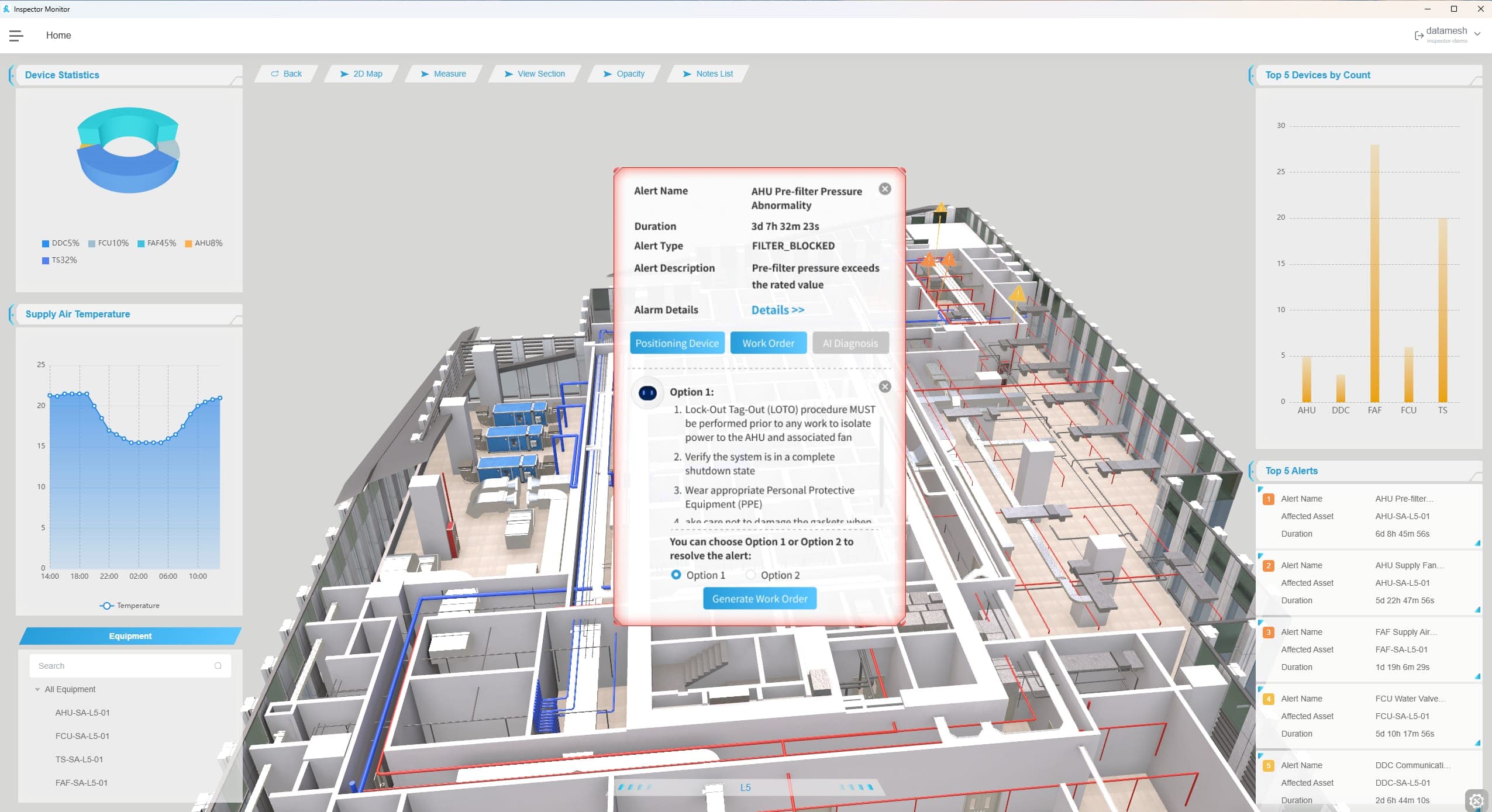
BIM becomes more valuable when it reaches operations
BIM gives project teams a rich design model, but operations teams need a working context that connects places, assets, systems, tasks, live conditions, and records. The useful question is how a model can support decisions after design review: where an issue is located, which asset is affected, which team owns the next action, and which evidence proves the result.
An operational digital twin carries BIM and 3D assets into field and facility workflows. It connects model geometry with asset identity, spatial hierarchy, data bindings, guided procedures, inspection records, work orders, and handover evidence. The model becomes a shared operating context for construction teams, owners, service providers, and facility teams.
This is especially important for MEP areas, equipment rooms, renovation floors, dense service corridors, data centers, campuses, and complex facilities where drawings, photos, issue lists, and system data are usually scattered across many tools.
What changes when BIM becomes operational
| Layer | Operational use |
|---|---|
| Spatial hierarchy | Site, building, floor, room, zone, route, access area, and safety boundary |
| Asset identity | Equipment IDs, system membership, tags, documents, owner, and maintenance responsibility |
| System relationships | Power, cooling, air, water, process, control, upstream and downstream dependencies |
| Data bindings | Sensors, meters, alarms, BMS, SCADA, IoT, CMMS, EAM, and work-history records |
| Field workflows | Installation guidance, commissioning checks, inspections, issues, work orders, and acceptance evidence |
| Facility workflows | Monitoring, maintenance, energy review, renovation planning, emergency response, and training |
| Governance | Model version, data source, owner, update process, quality review, and handover status |
The shift is from model visibility to operational continuity. Teams can use the same spatial context during construction, commissioning, handover, daily maintenance, and later renovation.
The DataMesh workflow
- Collect source models and records - Bring together BIM, CAD, point clouds, drawings, equipment lists, O&M documents, commissioning records, issue logs, and site photos.
- Create the spatial object model - Use FactVerse and Twin Engine to organize buildings, floors, rooms, zones, systems, assets, routes, and relationships.
- Connect data sources - Use Data Fusion Services to connect facility systems, enterprise systems, sensors, meters, alarms, documents, and work records where the workflow needs them.
- Author usable scenes - Use Designer to prepare scenes, labels, panels, behavior, floor switching, system views, and scenario presentations.
- Support field guidance - Use Director and DataMesh One to deliver installation guidance, inspection steps, commissioning procedures, training, and stakeholder review.
- Capture execution records - Use Inspector to capture issues, inspections, photos, corrective actions, work orders, acceptance notes, and verification status.
- Carry context into operations - Maintain the twin as the facility changes, so later maintenance, energy analysis, renovation, and emergency response use the same asset and space context.
The point is a continuous handoff from project data to operating data.
Workflows that benefit first
- Construction coordination: review MEP routes, dense equipment areas, hidden works, installation sequence, and field constraints in 3D context.
- Commissioning and handover: connect acceptance records, photos, asset IDs, commissioning documents, and remaining issues to the relevant room or equipment.
- Facility monitoring: bind live conditions, alarms, meter data, and equipment status to the twin so teams understand where events happen.
- Inspection and maintenance: turn spatial context into inspections, work orders, photos, corrective actions, and closure evidence.
- Renovation planning: review affected zones, access paths, nearby systems, equipment relationships, and field constraints before work starts.
- Energy and sustainability review: connect zones, systems, meters, asset relationships, and operating records to support facility analysis and Green Mark readiness evidence.
Start with a workflow where spatial context removes a real handoff problem.
Where DataMesh products fit
FactVerse provides the platform foundation for operational digital twins. It keeps asset, space, data, AI, simulation, and workflow context connected.
FactVerse Twin Engine turns BIM, CAD, point clouds, and operational records into a runtime context that applications can use.
Data Fusion Services connects operational data and business records to the twin. It helps map source data to assets, spaces, systems, and workflows.
FactVerse Designer prepares scenes, views, interactions, scenario explanations, and visual planning content.
Director supports guided procedures, installation guidance, training, and field-facing instructions.
Inspector manages inspection, work orders, issue closure, maintenance evidence, and facility records.
Together, these products help teams move from project visualization to a working operational twin.
Governance checklist
- Are BIM, CAD, point cloud, and drawing sources recorded with version and owner?
- Are buildings, floors, rooms, zones, systems, and assets named consistently?
- Are asset IDs aligned with enterprise asset records and maintenance systems?
- Are data bindings documented with source, unit, refresh rule, and quality status?
- Are field records linked to the correct space, asset, task, and scenario version?
- Are handover documents, photos, issues, acceptance notes, and commissioning records searchable from the twin?
- Are update responsibilities clear when construction status or facility configuration changes?
- Can facility teams use the same context for monitoring, inspection, maintenance, renovation, and training?
These checks turn a model conversion project into an operating asset.
Public references
The JTC and DataMesh collaboration shows BIM and mixed reality applied to construction sequence understanding and frontline work.
The Obayashi construction reference shows BIM data combined with mixed reality for construction process support.
The Toda SAGA Arena reference shows digital twin and mixed reality used to simulate and verify construction methods.
The TOKYO TORCH XR projection tour shows BIM-based digital twin visualization used for stakeholder communication around a planned building.