Fleet Triage and Criticality
Predictive Maintenance becomes more valuable when teams can compare assets, not only inspect one equipment record at a time. Fleet triage and criticality views help reliability owners prioritize limited maintenance capacity across equipment groups, sites, service lines, or production areas.
Fleet Review Flow
Prerequisites
| Requirement | Why it matters |
|---|---|
| Comparable equipment groups | Fleet review works best when assets share class, duty, or operating context. |
| Health and anomaly data | The attention list needs current operating evidence. |
| Criticality method | The team needs consistent severity and probability scoring. |
| Maintenance outcome history | Reliability metrics depend on closed work and outcome labels. |
| Planning owner | Someone must translate risk ranking into maintenance windows and work. |
Source Data Inputs
| Input | Use |
|---|---|
| Equipment profiles | Defines fleet membership and equipment class. |
| Health snapshots | Provides current and historical condition signals. |
| Anomaly records | Shows unresolved and repeated abnormal behavior. |
| Work-order outcomes | Feeds reliability and advisory precision review. |
| Business criticality | Adds production, service, safety, or compliance impact. |
Use Fleet Views for Triage
Start with fleet review when the question is about priority across many assets.
| View | What to review |
|---|---|
| Dashboard | Overall health distribution, active anomalies, and equipment groups needing attention. |
| Fleet | Equipment comparison, component attention, and health grouping. |
| Criticality | Risk matrix and attention list. |
| Maintenance | Upcoming work, repeated maintenance, and planning windows. |
| Reliability | MTBF, MTTR, availability, failure rate, and advisory outcomes where available. |
Fleet Risk Example
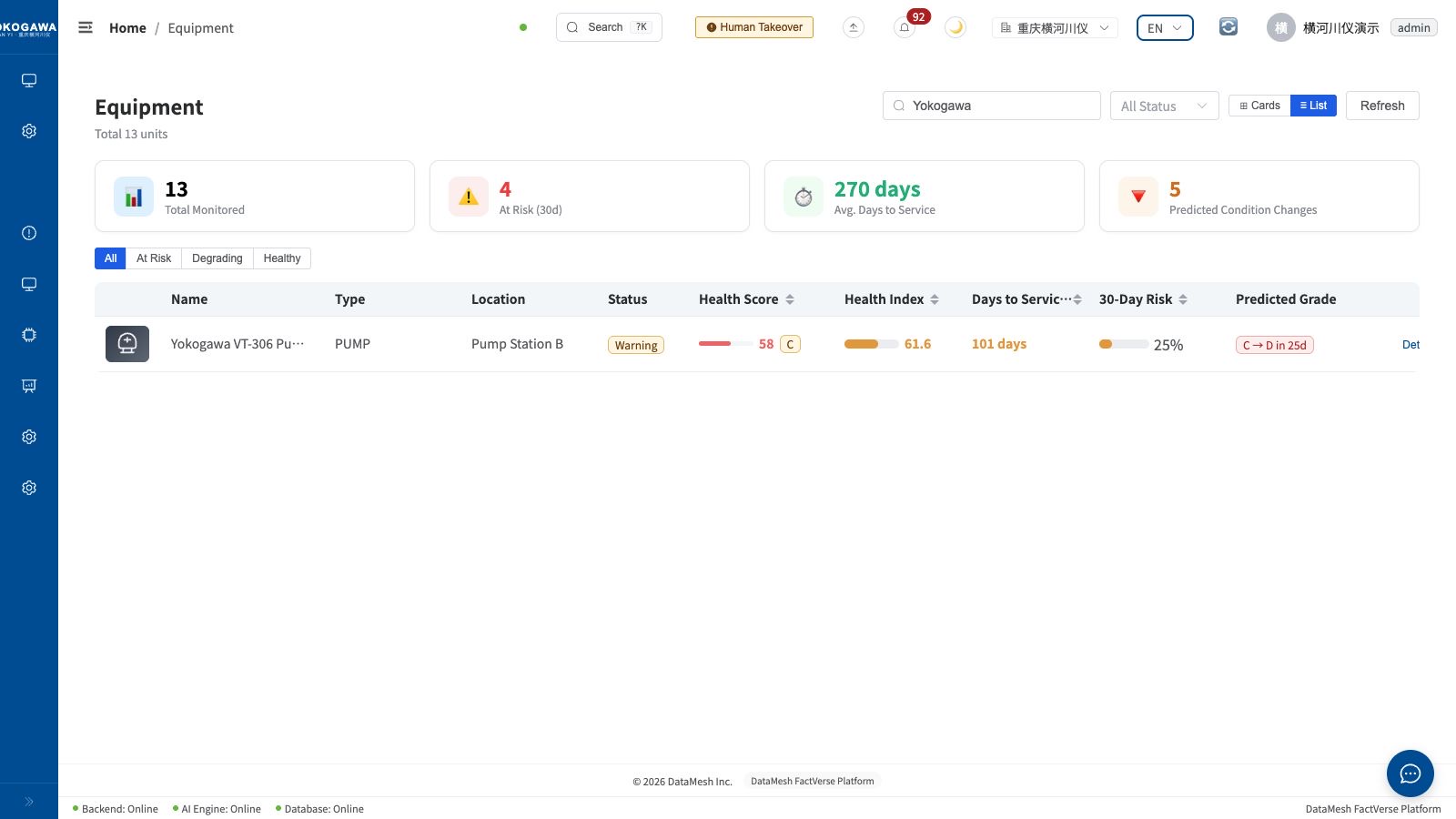
The equipment list can combine fleet totals with a focused asset review. In this sample tenant, the reviewer filters to VT-306 and compares its health score, Health Index, estimated days to service, 30-day risk, and predicted grade change before opening the equipment detail.
Criticality Inputs
Criticality should combine operating importance with maintenance evidence.
| Input | Example |
|---|---|
| Severity | Safety, production, service availability, cost, or compliance impact. |
| Probability | Health trend, anomaly recurrence, failure history, or known failure mode. |
| Detectability | Signal quality, inspection access, model readiness, or review confidence. |
| Maintenance strategy | Run-to-failure, preventive, condition-based, or predictive review. |
| Business context | Maintenance window, spare parts, service contract, and site priority. |
The criticality matrix is a planning aid. Teams should keep the scoring method consistent and review it when operating conditions change.
Prioritize Work
Use a simple decision ladder:
- handle high-severity assets with active critical anomalies first;
- review assets where health is degrading across repeated periods;
- check assets with repeated advisories but no closed outcome;
- validate data quality for assets with high risk but weak signal evidence;
- schedule lower-severity inspections during normal maintenance windows.
Reliability Review
Reliability metrics are strongest when work-order outcomes are complete.
| Metric | Use |
|---|---|
| MTBF | Review repeated failures and equipment classes with short intervals between failure-linked work. |
| MTTR | Understand repair duration and maintenance process bottlenecks. |
| Availability | Support service-level and production-impact review. |
| Advisory precision | Measure how often accepted advisories produce confirmed field findings. |
| Advisory recall | Compare advisory coverage against known failure events where the data supports it. |
Use these metrics as review signals with the data window, source systems, and outcome completeness visible.
Expected Output
Fleet triage should produce:
- a ranked list of equipment needing attention;
- the criticality rationale for high-priority assets;
- planning decisions for maintenance windows or inspections;
- data-quality follow-up for assets with weak evidence;
- reliability review inputs for recurring failure modes and advisory precision.
Monthly Review Agenda
A useful monthly reliability meeting can follow this agenda:
- review top attention-list equipment;
- review confirmed advisories and false positives;
- check repeated failure modes by equipment class;
- decide threshold or template changes;
- confirm work-order outcome capture quality;
- choose the next equipment scope for rollout.
Validation Checklist
- Fleet membership is based on a clear equipment class or operating boundary.
- Health and anomaly data use the same equipment identity model.
- Criticality scoring is reviewed by maintenance and operations owners.
- Work-order outcomes are complete enough for reliability review.
- High-priority items have an assigned action or review owner.
Troubleshooting
| Symptom | Check |
|---|---|
| Attention list feels noisy | Criticality weights, false-positive outcomes, and stale anomalies. |
| Similar assets rank inconsistently | Equipment class, operating duty, signal coverage, and maintenance history. |
| Reliability metrics shift sharply | Data window, closeout quality, and imported work-order history. |
| Planner cannot act on ranking | Maintenance window, spare parts, access, and work-order ownership. |