Safety decisions need a spatial view of the facility
Cleanroom and process-area monitoring provides critical observations at installed locations. A point sensor records conditions where it is mounted. A differential-pressure reading describes a selected boundary. An exhaust signal reports the state of a specific system. Together, these measurements help teams understand current operation.
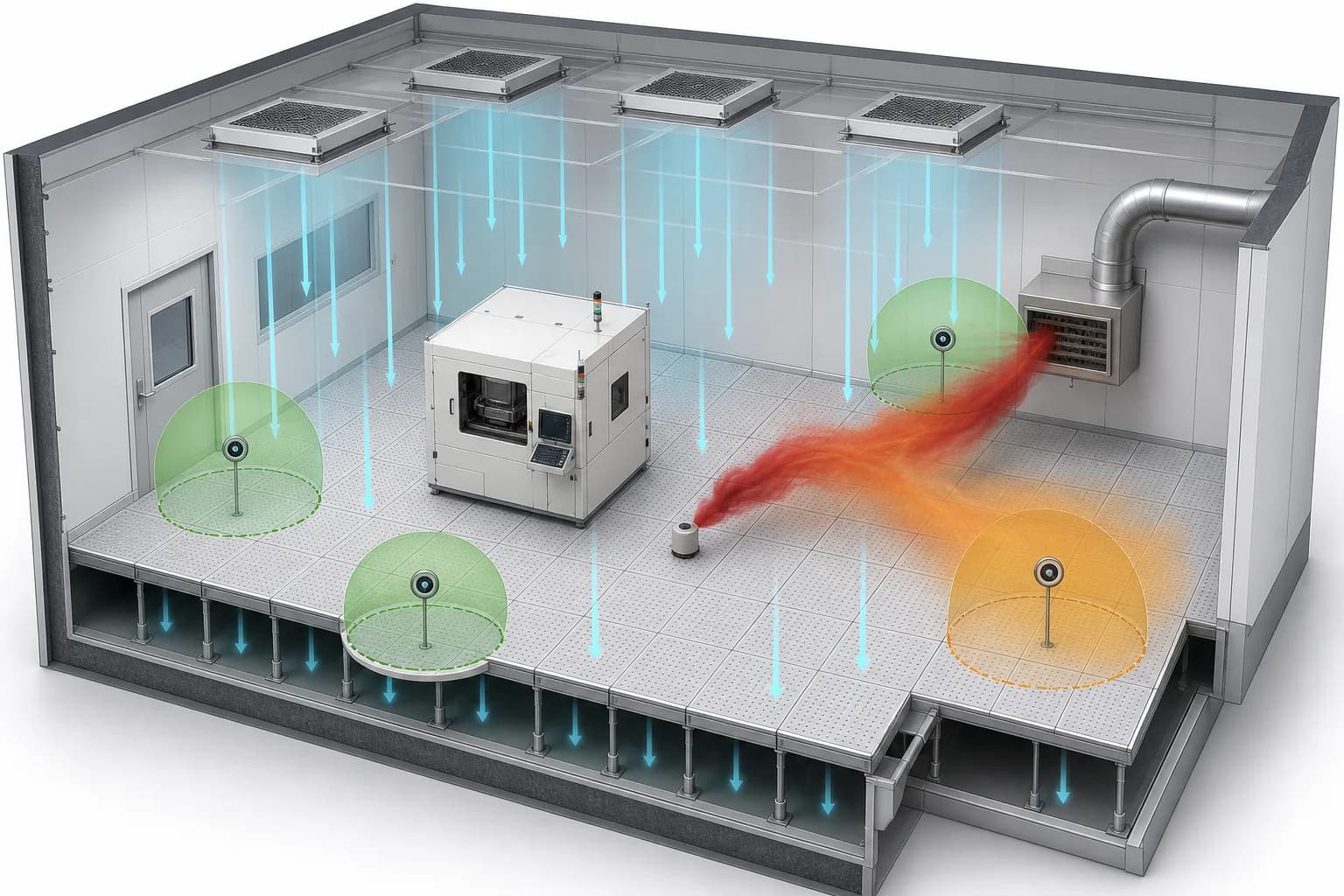
Airflow and gas-dispersion questions add a spatial dimension. Equipment, partitions, fan filter units, returns, doors, people, heat sources, and local exhaust can redirect air through paths that lie between sensors. A selected source may move differently as ventilation, tool layout, door state, thermal conditions, or exhaust performance changes.
A project-enabled study helps buyers evaluate those interactions for a defined decision. Typical questions include:
- How does a proposed tool or enclosure change airflow through the bay?
- Which zones may be affected by a selected release scenario?
- How much material reaches a local exhaust path under representative conditions?
- Which operating state produces the broadest affected area or longest persistence?
- Where would additional measurement, inspection, or engineering review add value?
Begin with the operational decision
The decision determines the model scope, evidence, and reviewer. A tool-installation review needs different source cases and geometry detail from a detector-placement study or an investigation of a recurring environmental alarm.
| Decision context | Evidence focus | Useful output |
|---|---|---|
| Proposed tool or layout change | Current and proposed geometry, equipment heat and airflow, supply, return, exhaust, doors, and operating states | Flow-field differences, recirculation zones, affected work areas, and review priorities |
| Selected release scenario | Source location, species properties, release profile, ventilation state, local exhaust, and relevant boundaries | Concentration histories, transport paths, affected zones, capture behavior, and persistence |
| Ventilation or exhaust change | Baseline and candidate airflow, pressure, control, capacity, and equipment states | Scenario differences, capture sensitivity, room relationships, and engineering checks |
| Monitoring or detector review | Source matrix, transport behavior, sensor position, response characteristics, and selected thresholds | Detection-time distribution, coverage comparison, potential blind spots, and placement options |
| Alarm or event investigation | Time-aligned facility data, equipment state, doors, work history, field observations, and representative scenarios | Evidence gaps, plausible dependencies, inspection priorities, and follow-up study scope |
This decision-first structure keeps technical effort aligned with business and safety value. It also gives procurement teams a clear basis for accepting the deliverable.
Build the facility and source baseline
The analysis should make every major input traceable. A practical baseline combines spatial, ventilation, source, measurement, and governance evidence.
Spatial and equipment context
- room, bay, sub-fab, utility space, ceiling, raised floor, wall, door, and opening geometry
- process tools, enclosures, workstations, partitions, storage, and major airflow obstructions
- fan filter units, supply diffusers, returns, general exhaust, local exhaust, ducts, and dampers
- detector, particle counter, pressure sensor, temperature sensor, and gas-monitor locations
- clean zones, pressure boundaries, occupied areas, egress paths, and response zones relevant to the decision
Ventilation and operating context
- supply, return, exhaust, pressure, temperature, humidity, and equipment-state evidence
- fan filter unit availability, local exhaust capacity, door state, controls, and operating mode
- equipment heat release, process state, people, and material movement represented by the study
- maintenance, filter, damper, fan, alarm, and environmental history related to the selected condition
Source and species context
- source location, height, orientation, geometry, and relationship to nearby capture points
- selected species and the physical properties used by the model
- release rate or profile, duration, temperature, momentum, and phase assumptions
- credible source variants and the engineering basis for each one
- concentration, dose, visibility, detection, or capture metrics selected for review
Governance context
- intended use, consequence of error, and responsible decision owner
- applicable facility, process, safety, and quality requirements
- evidence level, calibration target, acceptance criteria, and review route
- model limits, excluded conditions, revalidation triggers, and handover requirements
Data Fusion Services can align equipment identities, sensor locations, timestamps, units, alarms, maintenance records, and engineering sources. DataMesh FactVerse organizes the facility spaces, tools, utilities, detectors, and system relationships in an operational digital twin. FactVerse Designer supports prepared geometry, layouts, source cases, and scenario context for project-enabled analysis.
Translate a field into a reviewable result
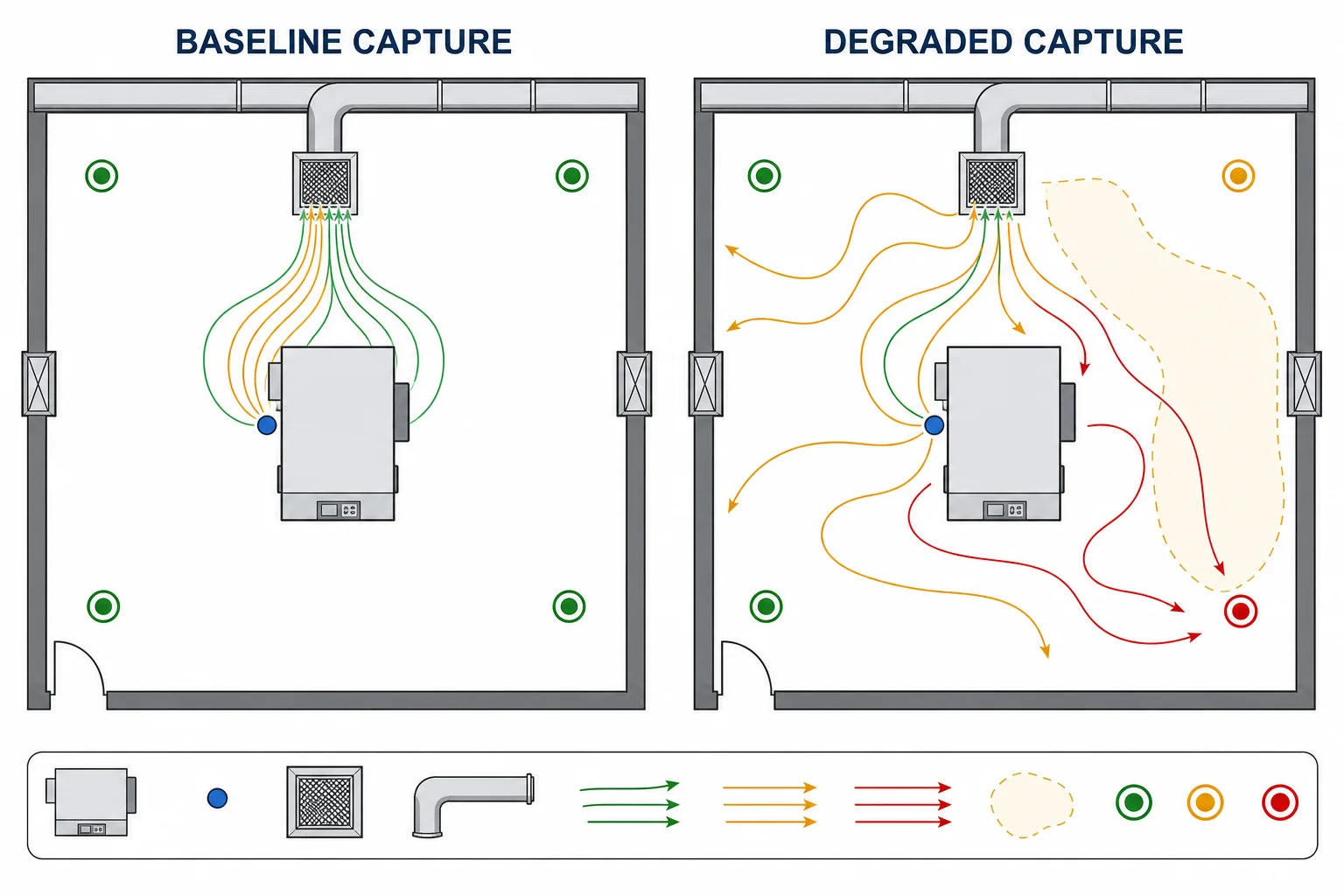
A spatial study relates a defined source and ventilation state to transport paths, affected zones, exhaust interaction, and detector locations.
Airflow and concentration fields become useful when they are connected to agreed metrics and locations. A buyer should expect both the spatial result and a concise decision summary.
Useful outputs can include:
- airflow direction, velocity, pressure, and thermal fields
- selected species concentration through space and time
- arrival time, persistence, peak, percentile, or integrated exposure metric at agreed locations
- fraction or amount directed toward a selected exhaust path
- zones that cross a project-defined review threshold
- comparison between baseline, candidate, degraded, and conservative scenarios
- sensitivity to source, airflow, door, exhaust, equipment, and boundary assumptions
- evidence confidence and the conditions covered by the conclusion
Thresholds should retain their source and intended use. A detector setpoint, occupational limit, process requirement, site action level, and model-comparison threshold serve different decisions. The report should identify which one is being used and who approved it for the study.
Keep monitoring and project analysis connected
| Working layer | Primary evidence | Operational role |
|---|---|---|
| Facility monitoring | Installed sensors, equipment states, alarms, trends, and environmental records | Describe observed conditions and initiate approved response workflows |
| Operational digital twin | Spaces, assets, utilities, detector locations, work history, documents, and ownership | Connect each signal and task to its facility context |
| Project-enabled physics analysis | Reviewed geometry, ventilation states, source scenarios, measurements, model checks, and uncertainty | Compare spatial behavior for a defined engineering or safety decision |
| Field execution | Approved inspections, assignments, procedures, observations, completion records, and verification | Carry qualified findings into controlled action and preserve the outcome |
This connected workflow keeps the analysis anchored to current assets and evidence. It also allows a completed inspection, ventilation change, or detector update to become part of the next baseline.
Match evidence confidence to the decision
An exploratory model supports relative pattern review and measurement planning under stated assumptions. A benchmarked model adds controlled reference checks. A measured-data calibrated model compares representative facility observations with model results. A scenario-specific validated study adds independent evidence for the variables and conditions relevant to the decision.
Cleanroom calibration evidence may include:
- airflow velocity and direction at relevant locations
- pressure relationships across selected boundaries
- supply, return, and exhaust measurements
- temperature or tracer concentration histories
- smoke visualization, tracer testing, or other qualified field evidence
- equipment, door, and ventilation states during each comparison period
- residuals by location, time, variable, and operating condition
The simulation calibration guide explains how evidence level affects claim confidence. The simulation evidence evaluation guide provides broader buyer questions for verification, validation, uncertainty, and handover.
Review multiple credible scenarios
One source and one ventilation state describe a narrow condition. A scenario matrix gives decision makers a clearer view of coverage and sensitivity.
Useful dimensions include:
- source location, orientation, release profile, and duration
- normal, reduced, and unavailable local exhaust
- fan filter unit or ventilation availability
- open, closed, and transition door states
- equipment, partition, and layout alternatives
- representative thermal and pressure conditions
- baseline and conservative model parameters
- repeated runs where numerical or physical variation affects detection timing
Reviewers should see which findings remain stable, which scenarios drive the largest affected zone, and which assumptions change the decision. The scenario ensemble guide describes how to select ranges and conservative review cases without treating a single run as the full evidence set.
Buyer checklist
Decision and scope
- Is one facility, process, safety, or monitoring decision clearly named?
- Are the spaces, tools, utilities, source cases, operating states, and time horizon defined?
- Is the consequence of an incorrect conclusion understood by the responsible reviewers?
Data readiness
- Are geometry, openings, tools, obstructions, supply, return, exhaust, and detector locations available?
- Are ventilation, pressure, temperature, equipment, door, and control states traceable?
- Does every measurement have an identity, location, timestamp, unit, and quality status?
- Is the engineering basis for each source case documented?
Evidence quality
- Are model checks, benchmarks, calibration residuals, uncertainty, and sensitivity visible?
- Are thresholds linked to their source and intended decision?
- Does the scenario matrix represent credible operating and degradation states?
- Does the claim stay within the variables, locations, and conditions supported by the evidence?
Review and handover
- Are engineering, environmental health and safety, process, quality, and compliance responsibilities assigned?
- Can each finding be linked to an affected zone, asset, detector, or utility system?
- Can approved follow-up enter inspection, maintenance, or change-management workflows?
- Are post-change verification and model-review triggers defined?
Scope a focused pilot
A practical pilot can begin with one cleanroom bay, utility space, or process area and one decision. The team verifies geometry and ventilation evidence, selects a manageable source matrix, agrees on review metrics and thresholds, and assigns qualified reviewers before the first final scenario is run.
Pilot success criteria can include:
- a verified facility, equipment, ventilation, and detector baseline
- traceable source cases and operating states
- reproducible fields, metrics, model checks, and scenario comparisons
- measured or benchmark evidence proportionate to the intended claim
- one planning, measurement, inspection, exhaust, or detector decision improved by the study
- an approved handover package linked to field action and verification
Explore Semiconductor Facility Operations and Cleanroom Analysis for the complete workflow across operations, engineering studies, AI-assisted investigation, and field execution.
Continue with Local Exhaust Capture and Ventilation Degradation Scenarios for resilience review, Detector Coverage, Blind Spots, and Placement Options for detector-layout comparison, and Cleanroom Calibration, Ensembles, and Validation Evidence for the evidence package behind higher-confidence decisions.
Public references
The American Society of Heating, Refrigerating and Air-Conditioning Engineers (ASHRAE) Clean Spaces handbook chapter describes cleanroom airflow patterns, the effect of equipment and openings, and the use of computational fluid dynamics to evaluate airflow and contaminant propagation.
The International Organization for Standardization (ISO) 14644-4:2022 cleanroom design, construction, and start-up page outlines the cleanroom lifecycle from requirements through design, construction, start-up, and verification.
The Occupational Safety and Health Administration ventilation technical manual explains the role of local exhaust ventilation in capturing contaminants near their source.
The National Institute of Standards and Technology review of industrial verification, validation, and uncertainty quantification describes model quality, verification, validation, and uncertainty as contributors to credible simulation evidence.