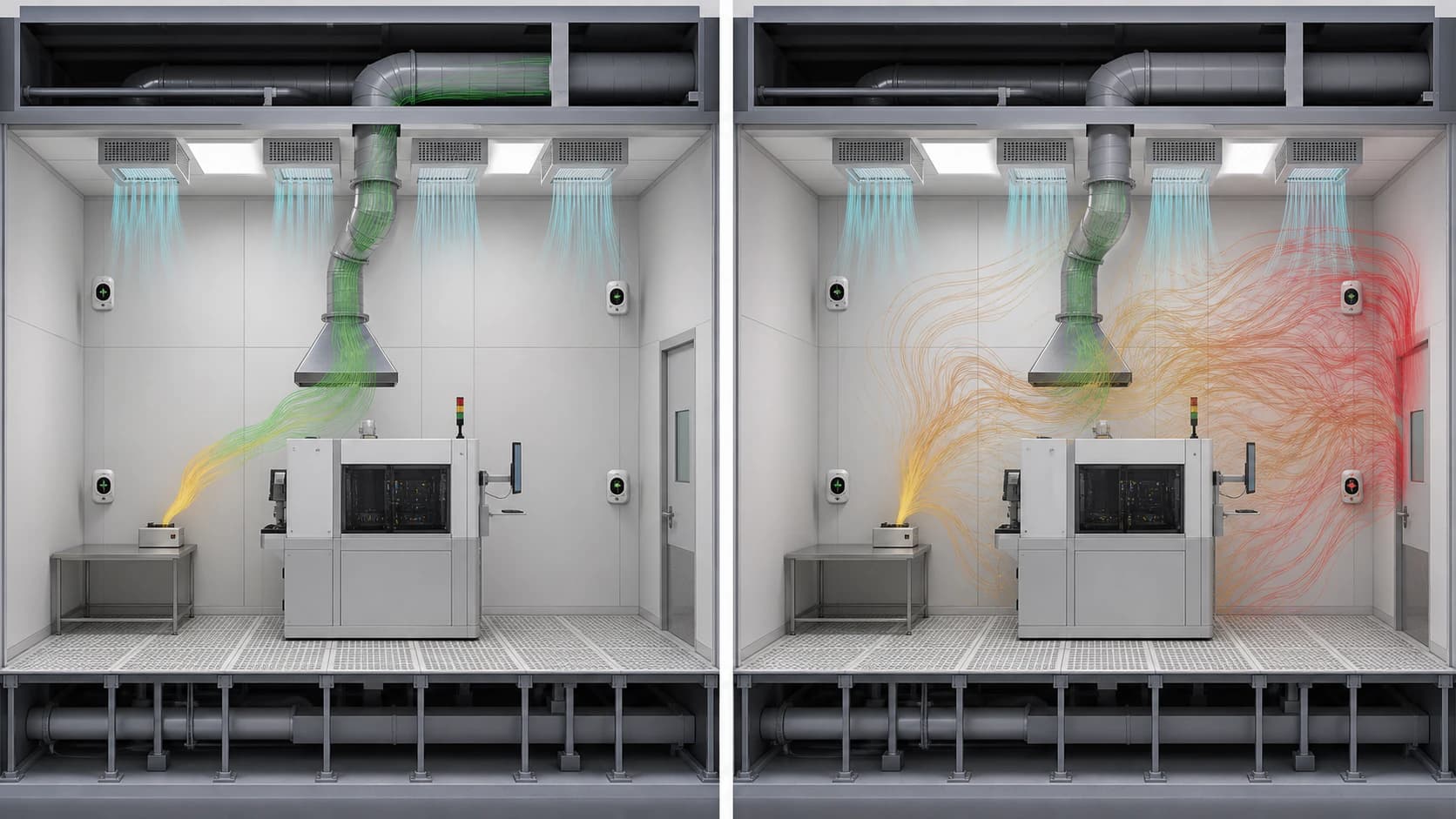
Capture performance changes as the facility changes
Local exhaust ventilation is intended to draw contaminants toward a capture point near the source. In a cleanroom, process bay, laboratory, sub-fab, or utility space, that behavior interacts with the wider heating, ventilation, and air-conditioning (HVAC) system, including room supply air, returns, fan filter units, pressure relationships, doors, equipment heat, operator movement, and nearby obstructions.
A hood or exhaust branch may report an active state while the surrounding flow field has changed. Reduced capacity, a shifted damper, an open access panel, a door transition, an equipment modification, or a new obstruction can alter the capture path and expand the area that deserves review.
A project-enabled scenario study helps teams examine those changes before a planned modification or as part of a resilience review. It supports questions such as:
- Which source positions remain well aligned with the capture path?
- How does reduced exhaust capacity change escaped material and affected zones?
- Which ventilation or door state creates the earliest spread beyond an agreed region?
- Which assets, sensors, and procedures deserve priority during a degraded state?
- What measurement or maintenance evidence would strengthen the decision?
Define normal and degraded states precisely
Scenario names should describe equipment and operating states that an engineer can reproduce and review.
| Scenario state | Example definition | Review question |
|---|---|---|
| Baseline | Verified exhaust flow, intended fan filter unit state, expected doors, representative process load, and current layout | What capture and room behavior does the accepted baseline produce? |
| Reduced capacity | Lower exhaust flow or pressure, partial fan performance, filter loading, damper restriction, or branch imbalance | Where does capture weaken, and which zones become more sensitive? |
| Unavailable component | Selected exhaust fan, branch, fan filter unit bank, or related utility removed from service | How does material move through the remaining ventilation paths? |
| Door or opening transition | Selected door, panel, access route, or temporary opening represented over time | How does the pressure and airflow disturbance affect capture and transport? |
| Layout or obstruction change | Proposed tool, enclosure, partition, storage, temporary equipment, or maintenance setup | Does the physical change redirect the source plume or room airflow? |
| Recovery | Equipment restoration, approved temporary measure, or return to the intended state | How quickly does the reviewed zone return to the accepted condition? |
Every scenario should identify its initial state, changed inputs, start time, duration, controls, represented response, and review horizon. This makes comparisons repeatable and prevents broad terms such as “fan failure” from carrying several conflicting interpretations.
Connect local capture with the room and utility system
Capture behavior should be evaluated in the context of the surrounding facility.
Local source and hood evidence
- source position, direction, release rate or profile, duration, momentum, temperature, and species properties
- hood, enclosure, slot, duct, branch, damper, and capture-point geometry
- measured or specified flow, pressure, face velocity, and equipment state
- source-to-capture distance and nearby tool, panel, operator, or maintenance obstruction
Room ventilation evidence
- supply diffusers, fan filter units, returns, general exhaust, doors, openings, and pressure boundaries
- airflow, pressure, temperature, humidity, and equipment-state measurements
- cleanroom classification and process requirements relevant to the study
- current and proposed tools, partitions, thermal loads, and operating modes
Operational evidence
- alarm, filter, fan, damper, exhaust, environmental, and maintenance history
- inspection findings, balancing records, commissioning evidence, and field observations
- door events, production states, work permits, and response timelines where relevant
- approved operating limits, action levels, procedures, and responsible teams
Data Fusion Services can align source systems, assets, measurements, events, and maintenance evidence. DataMesh FactVerse relates the exhaust branch, room, tool, detector, pressure zone, and responsible work process in a shared operational model.
Compare capture through fields and metrics
The primary comparison should preserve a common geometry basis, result scale, source definition, and review threshold. This allows reviewers to see the effect of the selected ventilation or exhaust change.
Useful spatial views include:
- airflow direction and velocity around the source and capture point
- pressure relationships across the room and adjacent spaces
- concentration fields and plume movement over time
- streamlines or transport paths that enter and leave the capture region
- zones affected under the baseline and degraded states
Useful decision metrics include:
- fraction or amount reaching the selected exhaust path
- escaped mass beyond an agreed capture or control region
- concentration history at selected work, access, sensor, or boundary locations
- arrival time, persistence, peak, percentile, or integrated review metric
- area or volume crossing a project-defined review threshold
- sensitivity to source strength, exhaust capacity, door state, layout, and boundary conditions
- recovery time after the approved response or equipment restoration
Each metric should identify its source conditions, calculation basis, units, time horizon, and evidence level. A capture percentage derived from an exploratory scenario carries a different decision value from a site-calibrated result supported by representative measurements.
Review time-dependent behavior
Ventilation degradation can unfold through transitions. A fan decelerates, a door opens and closes, a damper moves, a pressure relationship shifts, or a response begins after an alarm. Steady-state comparison provides a useful screening view, while transient analysis can show how the affected zone develops and recovers.
For a time-based result, the evidence package should state:
- the initial airflow and concentration field
- the equipment or door event and its timing
- the source profile over the same period
- represented controls and authorized response actions
- selected locations and review thresholds
- time-step, convergence, conservation, and repeatability checks relevant to the result
- sensitivity to response timing and influential assumptions
Reviewers should examine a range where response timing, equipment performance, or source conditions vary. The earliest credible spread, the most persistent affected zone, and the assumptions that change the outcome often provide more decision value than one central estimate.
Use evidence that matches the conclusion
Exploratory studies can compare relative capture patterns and identify missing measurements. Benchmarked studies add controlled reference cases. Site-calibrated studies use representative airflow, pressure, exhaust, temperature, tracer, or other qualified evidence. Scenario-specific validation adds independent checks for the conditions and metrics needed by the decision.
Relevant evidence may include:
- exhaust flow, pressure, face velocity, and fan or damper state
- airflow velocity and direction near the hood and across the room
- pressure relationships between selected spaces
- tracer concentration histories or qualified visualization evidence
- door, equipment, process, and ventilation states during measurement
- residuals by location, time, variable, and operating condition
- inspection and balancing records that confirm the represented configuration
The cleanroom airflow and dispersion guide explains the broader spatial evidence foundation. The simulation calibration guide shows how to align claim confidence with calibration and validation depth.
Turn resilience findings into controlled action
The scenario result should identify the affected spaces, tools, exhaust branches, detectors, utilities, and response owners. Qualified facility, process, environmental health and safety, quality, and compliance teams decide which actions enter the approved plan.
Potential follow-up can include:
- verify a sensor, damper, fan, filter, or exhaust branch in the field
- update balancing, inspection, or maintenance priorities
- add measurement coverage for a sensitive operating state
- review a door, access, temporary-equipment, or maintenance procedure
- refine the source matrix or run a targeted tracer or airflow test
- compare a layout, enclosure, hood, or ventilation modification
- update response triggers, ownership, or communication paths
FactVerse AI Agent can help teams relate alarms and abnormal trends to asset and maintenance context. Inspector can route approved checks and work, preserve field evidence, and record post-action verification.
Scenario coverage checklist
Baseline definition
- Is the intended source, hood, exhaust branch, room ventilation, and operating state verified?
- Are geometry, flow, pressure, control, door, equipment, and process states traceable?
- Are the accepted capture region, thresholds, and review metrics defined?
Degradation coverage
- Does the matrix include credible reduced-capacity and unavailable-component states?
- Are door, opening, layout, obstruction, and maintenance conditions represented where relevant?
- Are initial state, event timing, response timing, and recovery included for transient decisions?
- Are source location, strength, duration, and direction varied according to the risk basis?
Evidence quality
- Are benchmark, calibration, residual, uncertainty, and sensitivity records available?
- Which evidence was reserved for validation?
- Which findings remain stable across plausible conditions?
- Which assumptions have the greatest effect on escaped mass or affected zones?
Review and execution
- Is a qualified engineer responsible for the scenario conclusion?
- Are environmental health and safety, process, quality, and compliance reviewers assigned as needed?
- Can findings enter approved inspection, maintenance, procedure, or change workflows?
- Is post-change verification part of the handover package?
Start with one exhaust path and one credible degradation
A focused pilot can begin with one tool or source, one local exhaust path, and one degradation question. The team verifies current geometry and operating evidence, selects baseline and degraded states, agrees on capture and affected-zone metrics, and defines the evidence required for review.
Strong pilot criteria include:
- a verified source, hood, exhaust, room ventilation, and detector baseline
- reproducible normal and degraded scenario definitions
- visible capture, escaped-material, affected-zone, and time-based comparisons
- calibration and sensitivity evidence proportionate to the intended conclusion
- one approved resilience, inspection, maintenance, or measurement decision
- a reusable evidence and field-verification package
Continue with Detector Coverage, Blind Spots, and Placement Options when the resilience decision also depends on detection performance.
Use Cleanroom Calibration, Ensembles, and Validation Evidence to define calibration, repeated-run, validation, and revalidation requirements for the selected scenarios.
Public references
The Occupational Safety and Health Administration ventilation technical manual explains local exhaust ventilation as source capture and describes hood, duct, fan, air-cleaning, and measurement considerations.
The American Society of Heating, Refrigerating and Air-Conditioning Engineers (ASHRAE) Clean Spaces handbook chapter describes the influence of supply, return, exhaust, equipment, openings, and operating conditions on cleanroom airflow and contaminant movement.
The International Organization for Standardization (ISO) 14644-4:2022 cleanroom lifecycle page covers requirements, design, construction, start-up, verification, and lifecycle considerations for new and modified cleanroom installations.
The National Institute of Standards and Technology industrial verification, validation, and uncertainty review provides a general framework for credible simulation evidence.