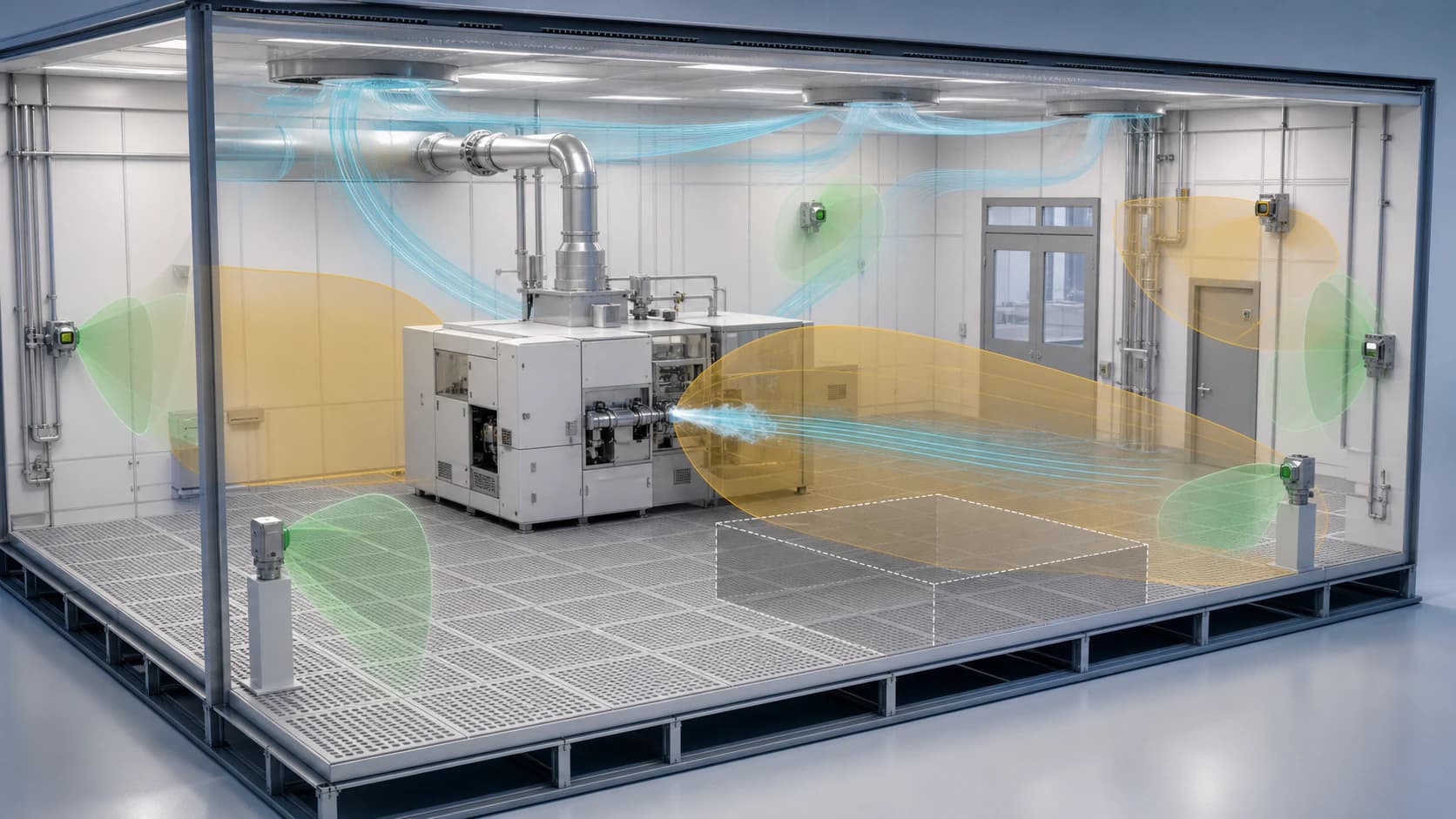
Detector placement is a spatial safety decision
A fixed gas detector responds to conditions that reach its sensing location and satisfy its response characteristics. Source location, release behavior, ventilation, equipment, exhaust, doors, pressure, thermal conditions, and nearby obstructions all influence that path.
Traditional placement rules, engineering judgment, vendor guidance, field experience, and regulatory requirements remain central to detector design. Project-enabled airflow and species-transport analysis adds a way to compare candidate layouts against a documented matrix of credible scenarios. It helps teams see which source and operating combinations produce prompt response, delayed response, or potential blind spots that deserve deeper review.
The buyer question is practical: which detector layout provides stronger evidence for the selected risks, and what additional controls, measurements, or engineering work remain necessary?
Define the safety decision and detection criterion
The study should begin with an intended use. Examples include reviewing a new tool installation, comparing detector positions, examining a ventilation change, assessing selected source locations, or identifying where additional field evidence would improve confidence.
The project team should agree on:
- the space, process, equipment, species, and source families in scope
- candidate detector technologies, positions, heights, orientations, and response characteristics
- the concentration, duration, dose, or device-response criterion used for the comparison
- the maximum review time or time-to-detection criterion relevant to the decision
- the ventilation, exhaust, door, equipment, and occupancy states represented
- the weighting or priority assigned to different scenarios
- responsible engineering, safety, detector-system, and compliance reviewers
A threshold should retain its source and meaning. Detector alarm settings, occupational limits, process action levels, emergency criteria, and model-comparison thresholds support different decisions.
Build a representative source and operating matrix
A scenario matrix turns broad risk language into reviewable cases.
| Scenario dimension | Examples to define | Why it matters |
|---|---|---|
| Source location | Tool connection, valve, cabinet, enclosure, utility chase, floor level, elevated point, or selected boundary | Location changes the initial transport path and nearby capture opportunity |
| Release behavior | Rate or profile, duration, direction, momentum, temperature, phase, and species properties | Source behavior affects buoyancy, mixing, travel, and concentration history |
| Ventilation state | Intended flow, reduced capacity, unavailable fan filter unit bank, reduced exhaust, altered damper, or selected recovery state | Ventilation controls the path and persistence of the released material |
| Door and opening state | Closed, open, transition, access panel, or temporary maintenance condition | Openings can change pressure and connect previously separated zones |
| Layout and obstruction | Current tool, proposed tool, enclosure, partition, storage, temporary equipment, or work setup | Physical changes can shield or redirect transport paths |
| Detector layout | Current position, candidate position, additional detector, alternate height, or alternate technology | Layout defines which paths and conditions can reach a sensor |
| Repetition and uncertainty | Parameter ranges, numerical variation, initial-state variation, or repeated runs | A distribution shows the stability and spread of detection outcomes |
Scenario selection should follow the facility's risk basis and intended decision. A clear matrix also lets reviewers see which conditions remain outside the evaluated scope.
Connect detector behavior with the facility model
Spatial evidence
- rooms, bays, sub-fabs, utility spaces, walls, floors, ceilings, doors, openings, and pressure boundaries
- tools, enclosures, cabinets, workstations, partitions, and major obstructions
- supply, return, fan filter units, general exhaust, local exhaust, ducts, and dampers
- current and candidate detector positions, heights, orientations, and access conditions
Operating evidence
- airflow, pressure, temperature, humidity, exhaust, and equipment-state measurements
- detector identity, technology, setpoint, response behavior, calibration, maintenance, and alarm history
- fan, filter, damper, door, process, occupancy, and work-state records relevant to the study
- current procedures, alarm routing, inspection, maintenance, and response ownership
Source and model evidence
- species properties and source profiles selected by qualified reviewers
- geometry and boundary sources, assumptions, model version, and scenario definitions
- benchmark, calibration, residual, validation, uncertainty, and sensitivity records
- detection calculation, threshold logic, repeated-run method, and evidence envelope
Data Fusion Services can align detectors, facility assets, measurements, alarms, and maintenance records. DataMesh FactVerse relates each detector and source scenario to spaces, tools, ventilation systems, and responsible teams. FactVerse Designer supports candidate layouts and prepared scenario geometry.
Review coverage as a scenario result
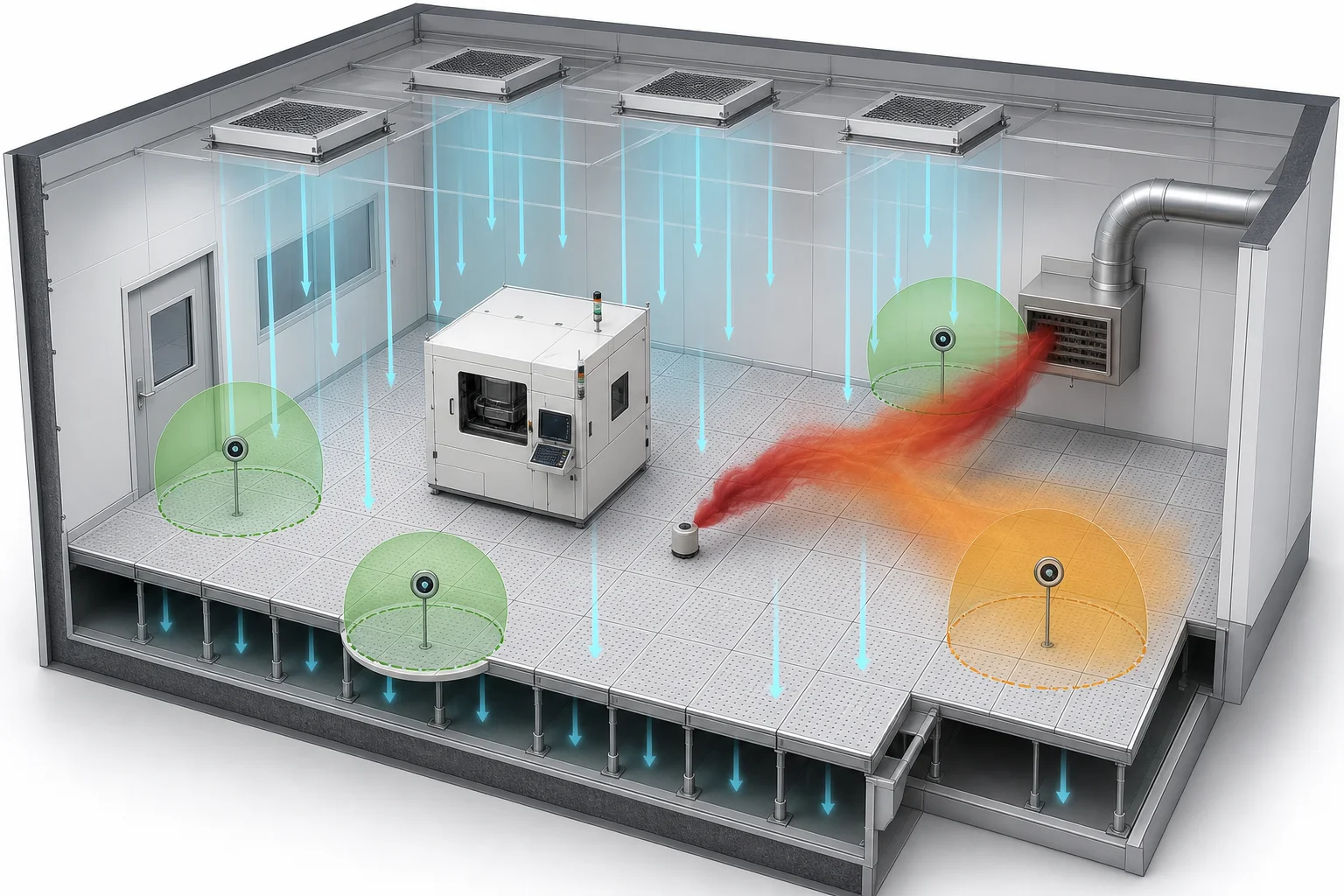
Detector coverage analysis compares how a defined layout responds across selected source and ventilation scenarios, then highlights cases that deserve engineering follow-up.
Coverage should always be reported beside the evaluated scenario set and detection criterion. A simple unweighted summary can be expressed as:
scenario coverage = scenarios meeting the agreed detection criterion / evaluated scenarios
Many projects need a richer view. High-priority source cases may carry greater weight. Different detector technologies may use different response models. Some scenarios may need separate reporting by room, process, source family, ventilation state, or consequence category.
Useful outputs include:
- detected and unresolved scenarios by source and operating state
- first responding detector for each scenario
- detection-time distribution and selected conservative statistic
- concentration history at each detector location
- coverage heatmap across source locations or zones
- overlap and dependency between detectors
- potential blind spots and scenarios with delayed response
- sensitivity to source, ventilation, door, layout, detector response, and threshold assumptions
- comparison between current and candidate layouts
The evidence package should preserve the result scale, scenario definitions, detector assumptions, and review threshold so options can be compared fairly.
Treat detection time as a distribution
Detection time varies with source, airflow, initial conditions, equipment state, detector response, and model variation. Repeated runs or a structured parameter ensemble can show the range and stability of that outcome.
Reviewers may examine:
- median and selected upper-percentile detection time
- earliest and latest credible detection within the evaluated set
- proportion of runs meeting an agreed criterion
- source and ventilation combinations that drive the slowest response
- detectors that respond consistently across the matrix
- scenarios where small input changes produce large timing differences
The chosen statistic should match the decision. A placement comparison may use conservative percentile results. A measurement-planning study may focus on sensitivity. A higher-consequence review may require stronger calibration, independent evidence, and formal approval ownership.
Identify potential blind spots responsibly
A potential blind spot is a scenario or location where the evaluated layout produces delayed, weak, or absent response under the agreed criterion. It enters qualified review as one part of the complete safety-system evidence.
Follow-up may include:
- verify the geometry, source, ventilation, detector, and threshold assumptions
- inspect the relevant space, detector, exhaust path, door, or equipment state
- add a measurement, tracer test, or targeted scenario
- compare detector height, orientation, technology, or location
- review local exhaust, enclosure, ventilation, or process controls
- revise alarm, inspection, maintenance, or response procedures through the authorized process
This approach keeps the analysis connected to the broader hierarchy of engineering and operational controls.
Use conservative scenario review
One scenario gives one outcome. A buyer should expect a matrix that covers credible source locations and operating states, together with a transparent method for selecting conservative review cases.
The scenario ensemble guide explains how to vary uncertain inputs, preserve scenario identity, and choose a decision case from the resulting range. The simulation evidence evaluation guide provides questions for verification, validation, uncertainty, and handover.
Evidence confidence should rise as the decision consequence rises. Exploratory analysis can prioritize locations and measurements. Benchmarked analysis can qualify the workflow. Site calibration can support facility-specific comparison within the measured range. Scenario-specific validation can strengthen a defined safety or engineering decision under relevant conditions.
Buyer evaluation questions
Decision and requirements
- Which process, source family, species, space, and detector decision are in scope?
- Which regulations, standards, facility requirements, vendor guidance, and risk controls apply?
- Which detection criteria and scenario priorities have responsible owners?
Scenario matrix
- Are credible source locations, profiles, directions, durations, and operating states represented?
- Are normal, degraded, door, exhaust, equipment, and layout conditions included where relevant?
- Are repeated runs or parameter ranges used when variation affects the result?
- Can every scenario be reproduced from the handover record?
Detector representation
- Are detector technology, position, height, orientation, setpoint, response, calibration, and maintenance status traceable?
- Does the response model match the intended comparison?
- Are current and candidate layouts evaluated on a common basis?
Evidence and review
- Are model checks, benchmark evidence, calibration residuals, uncertainty, and sensitivity visible?
- Which data or scenario was reserved for validation?
- Are coverage, detection-time distributions, and potential blind spots reported with their conditions?
- Who approves the final detector and safety decision?
Operational handover
- Can findings be linked to detectors, spaces, tools, exhaust paths, inspections, and work orders?
- Are field verification and commissioning activities defined?
- Are model-review triggers tied to tool, layout, ventilation, source, or detector changes?
Start with one zone and two layouts
A focused pilot can begin with one cleanroom bay, process area, utility space, or detector zone. The team selects a representative source matrix, verifies ventilation and detector evidence, and compares the current layout with one candidate option under agreed criteria.
Strong pilot outcomes include:
- a verified facility, ventilation, source, and detector baseline
- a documented scenario matrix and detection criterion
- reproducible coverage and detection-time comparisons
- visible potential blind spots, uncertainty, and sensitivity
- qualified review by facility, safety, detector-system, process, and compliance owners
- one approved measurement, placement, inspection, or engineering decision
- a reusable handover and field-verification package
Read Local Exhaust Capture and Ventilation Degradation Scenarios when detector performance also depends on selected ventilation or capture failures.
For the spatial foundation, read Cleanroom Airflow and Gas-Dispersion Evaluation. For benchmark, calibration, ensemble, validation, and revalidation requirements, continue with Cleanroom Calibration, Ensembles, and Validation Evidence.
Public references
The United Kingdom Health and Safety Executive guide on the selection and use of flammable gas detectors identifies process equipment, sensor type, gas properties, dispersion, ventilation, personnel, equipment protection, and detector redundancy as placement considerations.
The United Kingdom Health and Safety Executive (HSE) review of fire and explosion hazards in offshore gas installations reports that detector performance depends on dispersion, process activity, equipment layout, spacing, and ventilation information. Its industrial setting differs from a cleanroom, while the placement principles provide useful public context.
The American Society of Heating, Refrigerating and Air-Conditioning Engineers (ASHRAE) Clean Spaces handbook chapter describes cleanroom airflow and contaminant propagation as functions of supply, return, exhaust, equipment, openings, heat sources, and boundary conditions.
The National Institute of Standards and Technology publication on gas dispersion and optimum sensor placement demonstrates the use of computational fluid dynamics to evaluate flow-driven measurement placement and uncertainty in a different application domain.