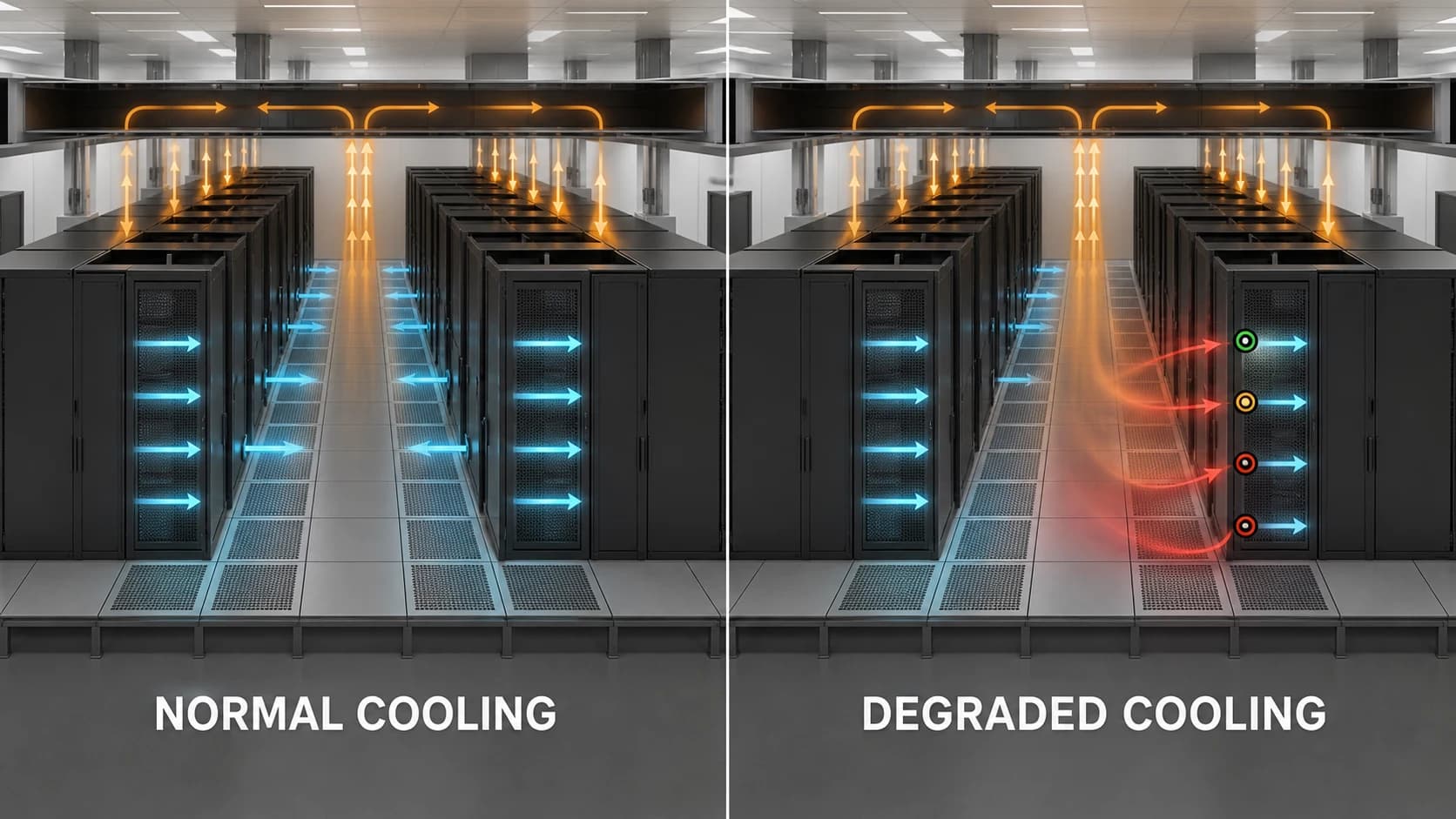
Confidence should rise with evidence
Calibration can make a simulation more representative of a specific facility, process, or operating condition. Its evidence strength still depends on the data coverage, comparison method, residuals, and independent checks. A model tuned against one temperature point during one operating period carries a different decision value from a model compared across multiple locations, loads, equipment states, and an independent validation period.
Technical buyers need a simple way to connect evidence depth with reasonable conclusions. Four levels are useful for early evaluation:
| Evidence level | Typical evidence | Suitable decisions | Reasonable claim scope |
|---|---|---|---|
| Exploratory | Reviewed geometry, engineering assumptions, documented inputs, basic quality checks, sensitivity to major variables | Concept screening, option comparison, measurement planning, pilot definition | Directional behavior and relative comparison under stated assumptions |
| Benchmarked | Exploratory evidence plus comparison with a recognized, controlled, or vendor-agreed reference case | Method qualification, workflow selection, known-behavior checks, baseline confidence | Performance against the defined benchmark and variables tested |
| Measured-data calibrated | Representative site measurements, selected physical parameters, calibration objective, residuals, acceptance limits, and review record | Site-specific scenario comparison, operational planning within the calibrated range, targeted what-if analysis | Magnitude, timing, or margin within the documented calibration envelope and remaining uncertainty |
| Scenario-specific validated | Calibrated model plus independent evidence under relevant conditions, robustness checks, uncertainty review, and qualified approval | Higher-consequence planning support, resilience review, engineering prioritization, defined operational decisions | Conclusions for the validated variables, locations, conditions, and intended use |
This four-level framework supports buyer evaluation. Certification and approval remain subject to the intended use, required rigor, domain review, and governance route defined for each project.
Calibration connects the model with observed behavior
A simulation combines geometry, topology, physical relationships, operating states, boundary conditions, and numerical methods. Some inputs are measured directly. Others come from design information, vendor documentation, engineering judgment, or assumptions that remain uncertain.
Calibration adjusts selected uncertain parameters so agreed outputs align more closely with representative observations. Examples include:
- airflow resistance, leakage, or equipment performance in a data-center thermal model
- supply, return, flow, pressure, building demand, or control parameters in a district-heating model
- local exhaust flow, filter or fan condition, source behavior, and boundary assumptions in a cleanroom dispersion model
- mass, friction, damping, stiffness, restitution, timing, or contact assumptions in a production and robotics model
The calibration target should follow the decision. A study of rack-inlet thermal margin needs evidence at relevant rack locations and operating loads. A detector-placement study needs time-dependent concentration and response evidence at relevant release and ventilation conditions. A robot handoff study needs motion and contact evidence tied to the task and asset state.
Use a visible calibration cycle
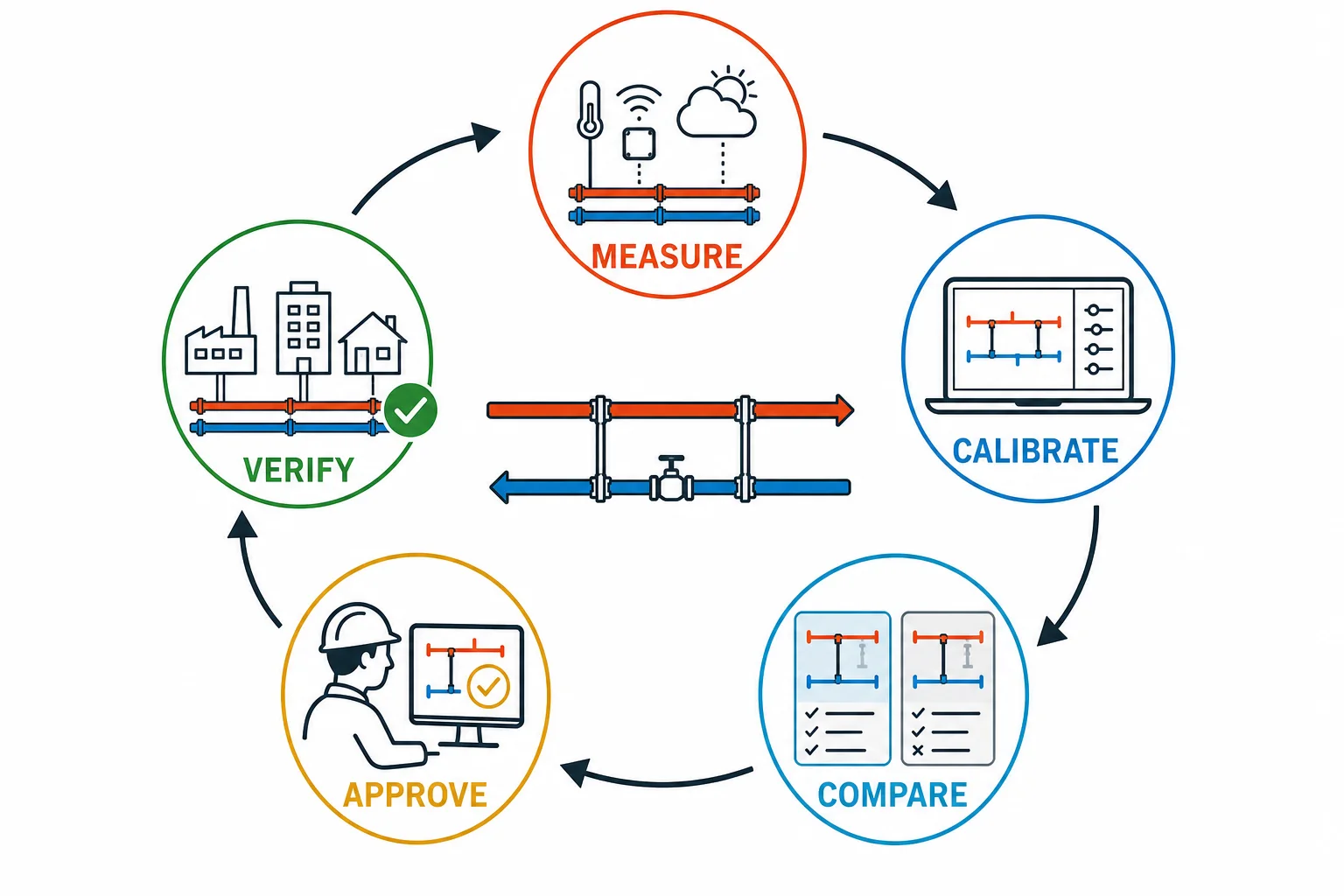
A calibration cycle links representative measurements with model adjustment, comparison, qualified review, and verification after conditions change.
A disciplined calibration cycle contains eight steps:
- Define the intended use - Name the decision, output variables, locations, time horizon, and consequence of error.
- Confirm measurement fitness - Review sensor identity, units, location, sampling, synchronization, calibration status, missing data, and operating-state coverage.
- Run the baseline model - Preserve the result before parameter adjustment so reviewers can see the original mismatch and the effect of calibration.
- Select physical parameters - Adjust parameters that have a defensible relationship to the modeled behavior and document their allowed ranges.
- Define the comparison objective - Choose the locations, periods, metrics, weighting, and acceptance limits used to evaluate fit.
- Calibrate against the selected data - Record the parameter changes, residuals, warnings, and fit across the full calibration set.
- Check independent conditions - Compare against a holdout period, operating state, test, or measurement set reserved from parameter tuning.
- Approve the evidence envelope - Document the conditions, variables, residual limits, uncertainty, reviewer, supported decisions, and revalidation triggers.
This record helps a buyer distinguish a repeatable engineering study from a result that was tuned until one image appeared plausible.
Read residuals as evidence
A residual is the difference between a measured value and the corresponding simulated value. A single average can hide important behavior, so reviewers should inspect residuals across the dimensions that matter to the decision.
Useful views include:
- residual by sensor or spatial location
- residual over time and operating state
- mean error and absolute error
- systematic positive or negative bias
- peak-condition and transition-period behavior
- spread across repeated or variable scenarios
- comparison between calibration and independent validation data
Residual acceptance should be defined before final review. The limit can reflect measurement uncertainty, operational tolerance, the variable's decision importance, and the consequence of error. A project may accept broader residuals for directional option screening and require tighter evidence for site-specific thresholds or timing.
Protect against a model that only fits the calibration data
Calibration quality depends on evidence coverage. Repeatedly adjusting parameters against the same narrow dataset can produce a close fit for that period while weakening confidence elsewhere.
Buyers should look for:
- multiple relevant spatial locations across the zones that affect the decision
- operating conditions that represent the intended decision range
- transitions and degraded states when resilience is in scope
- physically credible parameter ranges
- sensitivity analysis for influential parameters
- an independent period, condition, benchmark, or test
- stable findings under plausible data and parameter variation
The model should preserve physical meaning. A better aggregate score is valuable when local behavior, conservation, direction, timing, and system relationships also remain coherent.
Keep calibration and validation distinct
Calibration uses selected evidence to adjust uncertain parameters. Validation compares model output with suitable independent evidence for the intended use. A dataset used for parameter tuning provides limited independent proof, so a strong study reserves a separate period, condition, benchmark, or test for validation.
Validation evidence should state:
- the variables and locations compared
- the operating conditions represented
- the measurement or experiment uncertainty
- the residual or comparison metric
- the accepted range and review rationale
- the model conditions covered by the conclusion
- known mismatches and unresolved risks
Improved fit applies within documented conditions. New geometry, equipment, controls, loads, environmental states, or operating ranges can require new comparison evidence.
Match the claim to the calibration envelope
The calibration envelope is the range of conditions supported by the calibration and validation evidence. It may include load, temperature, airflow, pressure, equipment state, source strength, control mode, time horizon, or material behavior.
Examples of proportionate claims include:
| Evidence | Proportionate buyer conclusion |
|---|---|
| Exploratory model with reviewed assumptions | This scenario helps compare likely behavior and prioritize measurements or design options |
| Benchmark agreement for defined variables | This workflow reproduces the selected reference behavior within the reported comparison limits |
| Site calibration across representative operating data | The model supports site-specific scenario comparison within the documented operating range and residual limits |
| Independent scenario validation and robustness review | The model supports the stated decision for the validated variables and conditions, subject to recorded uncertainty and approval ownership |
Absolute accuracy language hides the conditions that give a result meaning. Buyers should ask for the envelope, residuals, uncertainty, and responsible reviewer beside any site-specific performance statement.
Understand uncertainty after calibration
Calibration reduces mismatch associated with selected parameters and evidence. Other uncertainty remains, including:
- measurement uncertainty and sensor placement
- missing or unobserved operating conditions
- geometry and topology simplification
- uncertain material or equipment behavior
- boundary-condition variability
- numerical approximation and discretization
- omitted interactions or disturbances
- future operating states beyond the observed range
Useful projects show which uncertainties influence the decision metric most. This can guide the next sensor deployment, test, data-quality improvement, benchmark, scenario family, or detailed engineering study.
Define revalidation triggers before handover
A calibrated model is an operational asset with a defined evidence envelope. The handover package should specify when its evidence needs review.
Common triggers include:
- material changes to facility layout, network topology, or production equipment
- changes to cooling, ventilation, exhaust, pumping, control, or safety systems
- new load ranges, process recipes, robot tasks, or operating modes
- sensor replacement, relocation, recalibration, or data-quality deterioration
- sustained residual drift beyond an agreed threshold
- observed field behavior that conflicts with the model
- a new decision with higher consequence or a different intended use
Revalidation can range from a data and residual review to targeted recalibration, a new benchmark, an independent test, or a full model update. The response should match the significance of the change.
Questions to ask before accepting a calibrated result
Intended use
- Which decision will this model support?
- Which variables, locations, conditions, and time horizon are covered?
- What consequence follows from an incorrect conclusion?
Data and calibration
- Which measurements were used, and were they representative of the intended use?
- Which parameters were adjusted, why were they selected, and what ranges were allowed?
- Was the baseline result preserved?
- Which residuals and acceptance limits were agreed before final review?
Independent evidence
- Which data or condition was reserved for validation?
- How did performance vary by location, time, load, and equipment state?
- Which findings remained stable under sensitivity or uncertainty analysis?
Claim and ownership
- What evidence level is being claimed?
- Which decisions are supported inside the calibration envelope?
- Which conditions require a new run or new evidence?
- Who approved the model, the evidence package, and the resulting action?
Choose the right evaluation next step
An exploratory assessment is suitable when the buyer needs to frame a decision, compare concepts, and identify missing evidence.
A benchmark study is suitable when a new method or workflow needs comparison with controlled reference behavior.
A measured-data calibration study is suitable when site-specific magnitude, timing, margin, or operating response matters and representative data are available.
A scenario-specific validation study is suitable when the decision has greater consequence and the buyer needs independent evidence under relevant conditions.
A focused pilot is suitable when the organization needs to prove data readiness, model usefulness, acceptance criteria, reviewer ownership, and handover requirements in its own environment.
Start by defining one decision and the evidence level it deserves. The simulation evidence evaluation guide provides a broader checklist for reviewing the complete evidence chain.
How DataMesh supports the evidence lifecycle
Data Fusion Services helps organize measured and engineering data with identity, time alignment, lineage, and quality context. FactVerse Designer maintains the spatial scene, behavior, scenarios, and versioned review context. DataMesh project workflows connect simulation fields with metrics, findings, actions, and qualified review.
Explore Process Simulation and Virtual Planning for production and robotics scenarios, Data Center Operations for thermal and resilience questions, Semiconductor Facility Operations for cleanroom airflow and detection studies, and Smart District Heating for network calibration and planning.
Public references
The National Institute of Standards and Technology review of industrial verification, validation, and uncertainty quantification describes physical-model quality, analyst quality, verification and validation, and uncertainty quantification as contributors to simulation credibility.
The NIST paper on calibration and uncertainty analysis of predictions from computational models discusses calibration against limited physical experiments and uncertainty from measurements and model inadequacy.
The American Society of Mechanical Engineers V&V 20 standard page describes validation for specified variables at specified validation points and treats broader interpolation or extrapolation as application-specific engineering judgment.
NASA's public Modeling and Simulations FAQ identifies input pedigree, verification, validation, uncertainty characterization, and result robustness as factors that inform a decision maker's credibility assessment.