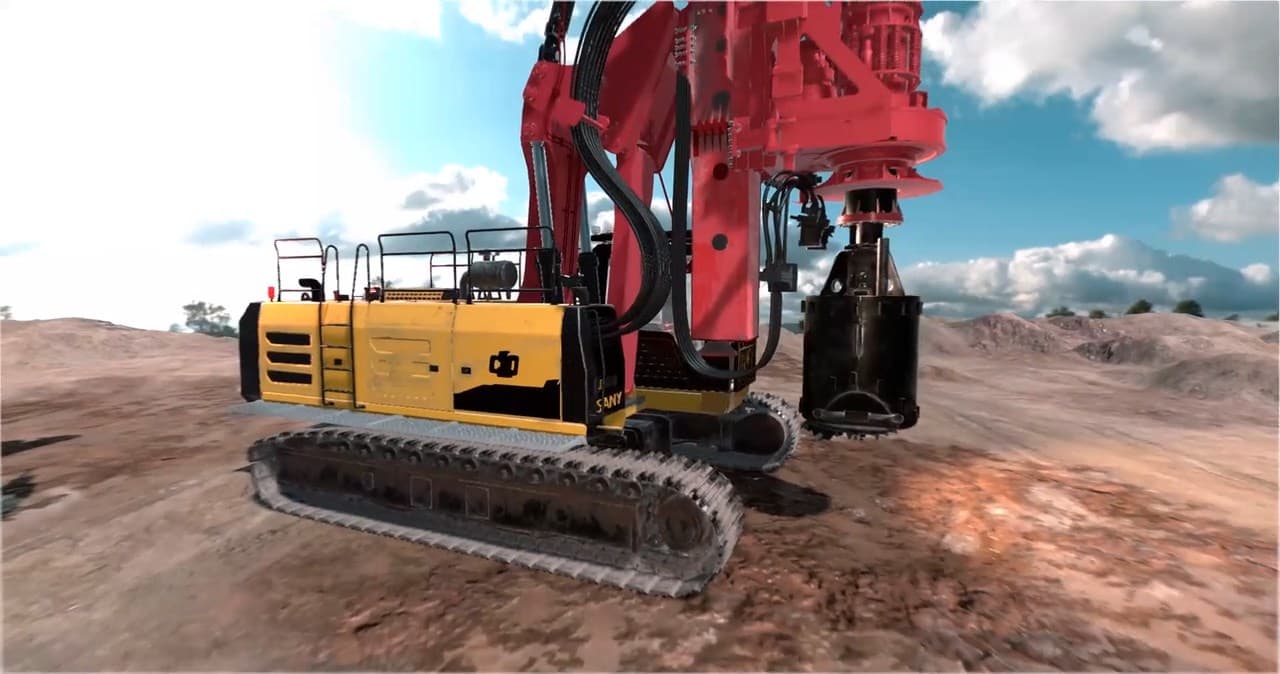
Heavy equipment training needs repeatable practice
Heavy equipment operator training is difficult to standardize because real machines are costly to reserve, job sites carry safety constraints, and experienced trainers have limited time. A trainee also needs more than a video or a checklist. They need to understand the machine, control response, work sequence, site context, risk points, and the quality of each action.
Digital twin simulator training gives teams a controlled way to practice those skills. The operator works through a scenario with realistic equipment behavior, physical or desktop controls, visual feedback, instructions, and assessment rules. Instructors can repeat the same task, compare results, and build a clearer record of competency.
For DataMesh, Simulator is the training surface for heavy equipment operation. It complements Director-authored SOP training, Designer-led scene planning, and FactVerse digital twin context.
What a simulator scenario should contain
| Layer | What it contributes |
|---|---|
| Equipment model | Geometry, scale, cabin view, moving parts, work range, and equipment-specific behavior |
| Physics behavior | Motion, collision, load response, ground interaction, vibration, and safety boundaries where relevant |
| Controls | Joysticks, pedals, panels, steering, desktop controls, or equipment-specific control layouts |
| Training procedure | Task steps, voice or text guidance, signal commands, checkpoints, and exception handling |
| Site context | Construction area, routes, obstacles, work zones, materials, nearby equipment, and weather or visibility conditions |
| Assessment | Time, accuracy, rule compliance, collision events, path quality, operation smoothness, and completion records |
| Review records | Trainee profile, scenario version, score, notes, replay evidence, and instructor feedback |
The strongest scenarios bring these layers together. A tower crane lift, forklift route, drilling rig task, deep well casing drilling routine, or excavator operation should feel like a structured job task with clear steps, constraints, feedback, and scoring.
Equipment coverage and scenario design
DataMesh Simulator supports training programs for tower cranes, forklifts, rotary drilling rigs, deep well casing drilling rigs, excavators, and other heavy equipment. Each program should start from the training objective: basic familiarization, operating sequence, emergency response, certification practice, overseas service training, or instructor-led assessment.
The training objective then determines the hardware form, scene fidelity, control setup, scoring rules, and content depth. Some teams need a full motion platform and cabin. Some need a desktop station for early familiarization. Some need a portable setup for distributed training. The right design depends on the equipment, learner level, training location, and assessment requirement.
This is why simulator content should be planned as an equipment training program. The model, controls, scenario, score, and review process all need to match the operating skill being taught.
The DataMesh workflow
- Define the training role - Identify the equipment type, operator role, target skill, safety focus, and assessment requirement.
- Build the equipment twin - Prepare the equipment model, moving parts, cabin view, control mapping, physics behavior, and scenario environment.
- Author the training path - Create task steps, guidance, prompts, checkpoints, signal commands, and exception cases.
- Configure the training station - Select motion platform, cabin, control panel, desktop station, visual system, or a mixed setup based on the scenario.
- Run practice and assessment - Let trainees repeat tasks, receive feedback, and complete structured evaluations.
- Record evidence - Store scores, completion records, instructor notes, scenario versions, and review evidence.
- Improve the course - Update scenarios when equipment, procedures, site rules, or training goals change.
The result is a reusable training system with scenario versions, instructor review, assessment evidence, and a path for course updates.
Where Simulator fits in the FactVerse stack
Simulator owns heavy equipment operator training. It is used when the training goal depends on equipment behavior, control response, physical interaction, and operator assessment.
FactVerse provides the digital twin platform foundation. FactVerse Twin Engine keeps assets, scene context, behavior, and scenario state organized.
FactVerse Designer supports scene authoring, layout planning, and scenario preparation. Director supports guided SOPs and interactive training content. Inspector supports field records, inspections, issue closure, and evidence workflows after training connects to site execution.
Together, these products help training teams connect equipment practice with the same digital twin context used for planning, guidance, and operations.
Public Steam reference version
DataMesh publishes Operator Training: Heavy Equipment on Steam as a simplified public reference experience. The Steam listing names DataMesh as developer and publisher and presents a lightweight heavy equipment simulator experience for public users.
That public version is useful for understanding the concept: machine operation, guided practice, visual scene context, and equipment simulation in an accessible format. Enterprise and education deployments add project-specific hardware, control systems, course content, scoring criteria, cabin design, motion platform options, and integration requirements.
Evaluation checklist
- Does the scenario match a real operating task or assessment goal?
- Does the equipment model include moving parts, control behavior, and relevant physics assumptions?
- Does the hardware setup match the learner stage and training objective?
- Are task steps, signal commands, checkpoints, and exceptions defined clearly?
- Are scoring rules tied to safe and correct operation?
- Can instructors review replay evidence, notes, scores, and scenario versions?
- Can training records connect to a broader learning management, safety, or operations workflow?
- Can the course be updated when equipment, site rules, or procedures change?
These questions keep simulator training tied to operator competency and operational readiness.
Public references
DataMesh has public Simulator updates for tower crane training, crawler excavator training environments, the digital twin based Simulator Platform, and Simulator 2.2.
The Operator Training: Heavy Equipment Steam listing provides a public reference for a simplified heavy equipment training experience published by DataMesh.