
Start with the decision at risk
A simulation earns trust when its evidence is appropriate for the decision being made. A visually convincing airflow field, temperature map, robot motion, or network model can help people understand a scenario. The decision still depends on deeper questions: which operating condition was represented, where the inputs came from, how the model was checked, what variation was explored, and who is qualified to accept the conclusion.
This matters because industrial simulation supports decisions with very different consequences. An early layout screening study can tolerate broader assumptions. A cleanroom gas-dispersion review, a data-center cooling-failure scenario, or a robot safety decision requires stronger evidence and tighter review.
The first evaluation question is therefore:
What decision will this result support, and what happens if the conclusion is wrong?
That answer determines the geometry, data, calibration, uncertainty analysis, review depth, and approval ownership the project needs.
Follow the evidence chain
A useful review follows the result from the decision question back to the model and inputs, then forward into findings and action.
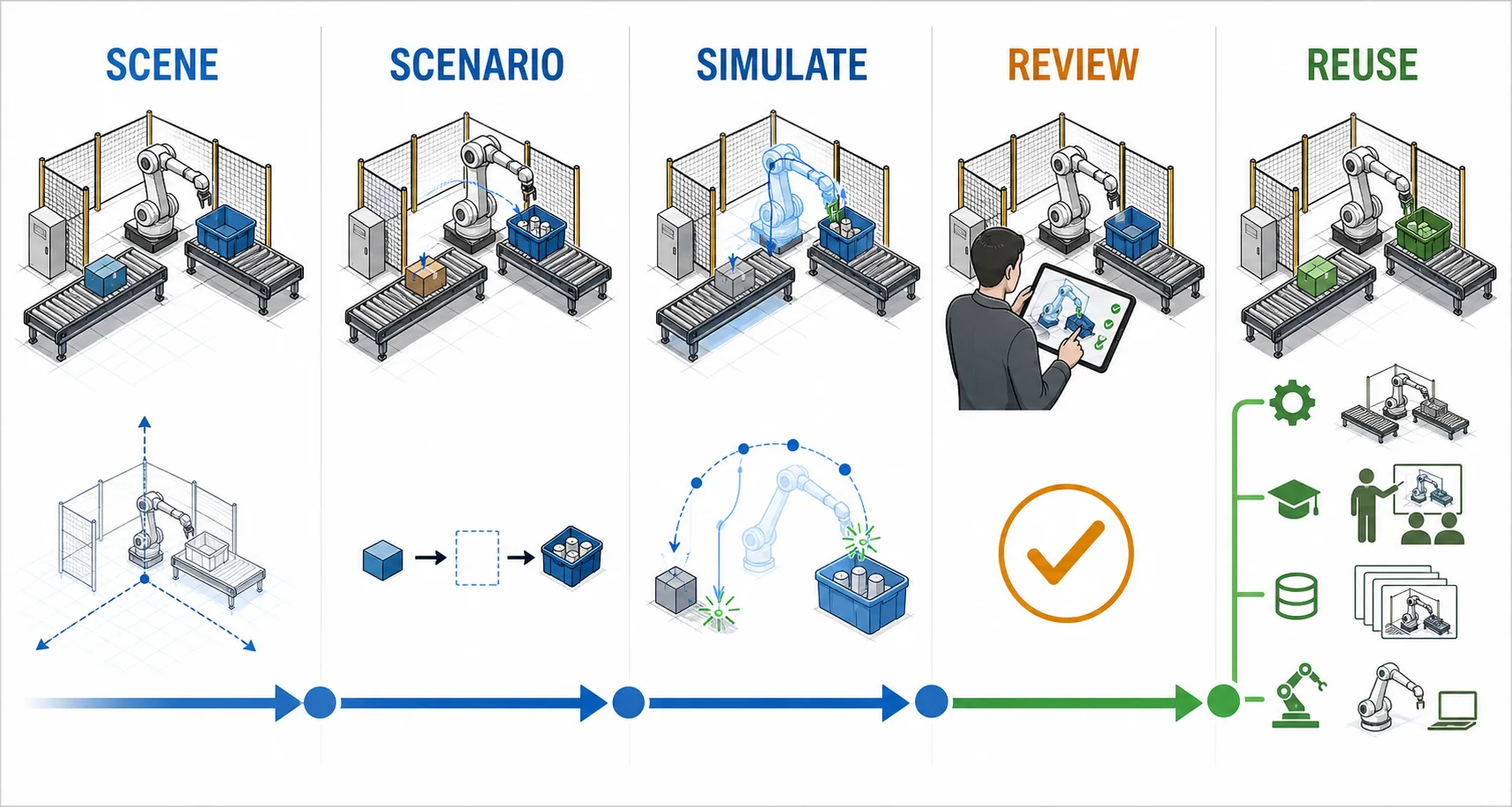
A reusable scene becomes decision evidence only after the scenario, assumptions, outputs, and review are connected to an intended use.
The evidence chain has seven links:
- Decision and consequence - State the engineering or operational question, the affected assets and people, the decision owner, and the consequence of error.
- Scenario boundary - Define the operating state, geometry, time window, loads, disturbances, equipment availability, environmental conditions, and exclusions.
- Model and input identity - Record the scene, asset, model, input dataset, boundary condition, configuration, and software version used for the run.
- Simulation fields - Inspect the spatial and time-dependent outputs that represent the modeled behavior, such as temperature, velocity, concentration, pressure, flow, contact, or motion.
- Metrics and operating limits - Translate fields into reviewable measures such as rack-inlet temperature, time to detector response, capture effectiveness, thermal margin, pressure differential, network imbalance, clearance, or collision state.
- Findings and actions - Connect observed conditions to a specific engineering finding, proposed action, priority, and expected operational effect.
- Qualified review - Record who reviewed the inputs, method, limitations, findings, and proposed decision, including unresolved questions and required follow-up.
A break anywhere in this chain weakens the decision. A field without a decision metric is difficult to act on. A metric without a traceable input set is difficult to reproduce. A recommended action without a named reviewer is difficult to govern.
Ask what the model was intended to represent
Simulation quality is always tied to an intended use. The same model may be suitable for comparing two layouts and unsuitable for predicting an exact site threshold.
Ask the project team to state:
- the physical or operational behavior represented
- the assets, spaces, systems, and time horizon included
- the variables and interactions simplified or excluded
- the range of operating conditions covered
- the locations and conditions where evidence was compared with measurements or benchmarks
- the decisions supported at the current evidence level
- the conditions that require a new run, recalibration, or deeper method
This context should appear beside the result and remain understandable without requiring the evaluator to know how the model was built.
Separate verification, calibration, and validation
These activities answer related questions:
| Review activity | Buyer question | Useful evidence |
|---|---|---|
| Model and setup review | Does the scenario represent the intended assets, conditions, and interactions? | Geometry review, topology checks, units, material assumptions, boundary conditions, operating-state confirmation |
| Verification | Was the computational problem solved consistently enough for the intended result? | Convergence behavior, conservation checks, mesh or time-step sensitivity where relevant, numerical warnings, repeatability |
| Benchmark comparison | Does the workflow reproduce a recognized or controlled reference case? | Reference definition, expected behavior, comparison metric, deviation, acceptance rationale |
| Measured-data calibration | Were uncertain model inputs adjusted against representative site observations? | Measurement source, calibration period, adjusted parameters, residuals, holdout conditions, reviewer sign-off |
| Validation for intended use | How well does the result agree with independent evidence under relevant conditions? | Independent measurements or tests, comparison locations, uncertainty, limits of applicability, observed mismatch |
The evidence level should match the claim. Early scenario screening may rely on geometry, engineering assumptions, and sensitivity checks. Site-specific threshold or timing claims call for representative measurements, documented residuals, and independent review.
Inspect inputs before outputs
Many weak reviews begin with the most attractive output image. A stronger review begins with the input pedigree.
For each important input, ask:
- Who owns the source data?
- When and where was it collected?
- Which units, coordinate system, sampling interval, and time synchronization apply?
- Has missing, stale, duplicated, or impossible data been identified?
- Does the dataset represent the simulated operating condition?
- Which values came from measurement, design information, vendor documentation, engineering assumption, or calibration?
- How sensitive is the decision metric to this input?
Data Fusion Services can help organize operational and engineering data with identity, lineage, quality context, and time alignment. FactVerse Designer maintains the spatial scene, behavior, scenario, and review context. The value for evaluation comes from preserving the connection between those inputs and the result being discussed.
Require metrics that connect to action
Color fields are valuable for exploration, but an engineering review also needs metrics tied to operating limits and action.
Examples include:
| Scenario | Field | Decision metric | Possible action |
|---|---|---|---|
| Data-center thermal resilience | Temperature and airflow over time | Rack-inlet margin and time to an agreed limit | Review load placement, containment, operating sequence, or cooling resilience option |
| Cleanroom release scenario | Concentration and velocity over time | Detection time, undetected region, and local exhaust capture behavior | Review detector placement, exhaust condition, response sequence, or validation plan |
| District-heating operation | Flow, pressure, and temperature across the network | Imbalance, return-temperature behavior, and service condition by zone | Review balancing, control, maintenance, or severe-weather operating scenario |
| Production and robotics | Motion, contact, clearance, and process state | Collision, handoff stability, access envelope, and sequence completion | Revise layout, timing, asset properties, task definition, or physical test plan |
The project should explain how each metric was calculated, which threshold or comparison basis applies, and who owns the action. A model can reveal an engineering concern without automatically selecting the final remedy.
Review uncertainty and result stability
A single run shows one combination of inputs and assumptions. Buyers should ask which changes could alter the finding.
Useful review methods include:
- varying uncertain boundary conditions and operating states
- comparing equipment-available and equipment-degraded scenarios
- testing plausible measurement error or input ranges
- checking mesh, time step, or solver-setting sensitivity where the method requires it
- running scenario families or repeated runs for variable conditions
- reporting distributions, percentiles, ranges, or conservative cases when they are decision-relevant
- identifying the inputs that dominate the decision metric
The result package should distinguish stable findings from findings that change materially under plausible variation. This helps the buyer decide whether to act, gather more evidence, narrow the claim, or run a targeted pilot.
Make the run reproducible
Reproducibility is practical governance. Another qualified reviewer should be able to identify the exact scene, model, inputs, conditions, and settings behind the result and understand how the published finding was produced.
A reviewable run record should include:
- decision question and scenario identifier
- scene, geometry, asset, and model versions
- input dataset identity and applicable time range
- assumptions and boundary conditions
- method, configuration, and relevant software version
- warnings, checks, and quality observations
- output fields, metrics, units, and comparison basis
- reviewer, review date, disposition, and open actions
Checksums or immutable identifiers can strengthen traceability when the project needs formal evidence control. Buyers generally need the clear review record rather than internal implementation detail.
Use a buyer evaluation checklist
Decision fit
- Is the intended decision stated in one sentence?
- Is the consequence of a wrong conclusion understood?
- Does the evidence depth match that consequence?
- Are the decision owner and technical reviewer named?
Scenario and input quality
- Are included and excluded conditions explicit?
- Are geometry, topology, units, coordinates, and time alignment checked?
- Are measured values, design values, vendor data, and assumptions distinguishable?
- Do the inputs represent the operating condition under review?
Method and evidence
- Are verification, benchmark, calibration, or validation activities appropriate for the intended use?
- Are residuals, deviations, warnings, and unresolved mismatches visible?
- Has sensitivity to important inputs been explored?
- Can the team reproduce the result from the recorded run identity?
Findings and action
- Does every important finding point to a field, metric, limit, or comparison?
- Are stable and sensitive findings distinguishable?
- Are proposed actions assigned to an accountable owner?
- Are additional measurement, engineering analysis, physical testing, or approval steps clear?
Choose the next evidence step
The appropriate next step depends on the decision and the current evidence gap.
Request a benchmark study
Use a benchmark when the team needs to establish that the method reproduces known behavior under controlled conditions. This is especially useful before applying a new solver, model family, or workflow to a high-impact decision.
Request measured-data calibration
Use calibration when the decision depends on site-specific magnitude, timing, threshold margin, or equipment response and representative measurements are available. Define the calibration period, adjusted parameters, residual measures, and conditions reserved for independent comparison.
Request a focused pilot
Use a pilot when the buyer needs to prove data availability, geometry readiness, model usefulness, review ownership, or workflow fit in the operating environment. A strong pilot chooses one decision, defines the evidence package before modeling begins, and sets explicit expansion criteria.
Escalate to detailed engineering or physical testing
Use specialized analysis, vendor engineering, commissioning tests, or physical trials when the decision requires construction-ready approval, safety sign-off, material qualification, equipment certification, or evidence beyond the current model's intended use.
Build trust through visible evidence
DataMesh connects reusable digital-twin scenes, governed operational data, simulation outputs, findings, actions, and review records so technical buyers can evaluate the full decision chain. The engagement should begin with one concrete question and the evidence needed to answer it.
For process and robotics planning, explore Process Simulation and Virtual Planning. Facility teams can review the market context for Data Center Operations, Semiconductor Facility Operations, and Smart District Heating.
Public references
The National Institute of Standards and Technology summary of industrial verification, validation, and uncertainty quantification describes physical-model quality, analyst quality, verification and validation, and uncertainty quantification as fundamental contributors to simulation credibility.
NASA's public Modeling and Simulations FAQ explains credibility factors including data pedigree, verification, validation, input pedigree, uncertainty characterization, result robustness, use history, and process management.
The American Society of Mechanical Engineers overview of verification, validation, and uncertainty quantification standards lists current terminology, solid-mechanics, fluid and heat-transfer, validation-metric, and simulation-software evaluation standards.
These references provide general evaluation principles. Each industrial project still needs an intended-use statement, domain expertise, suitable evidence, and the approvals required by the buyer's organization.