Industrial World Models for Physical AI: Connecting Data, Structure, and Physics
How FactVerse organizes industrial data, asset relationships, and physics-based simulation into a repeatable environment for AI across data centers, semiconductor cleanrooms, and manufacturing lines.
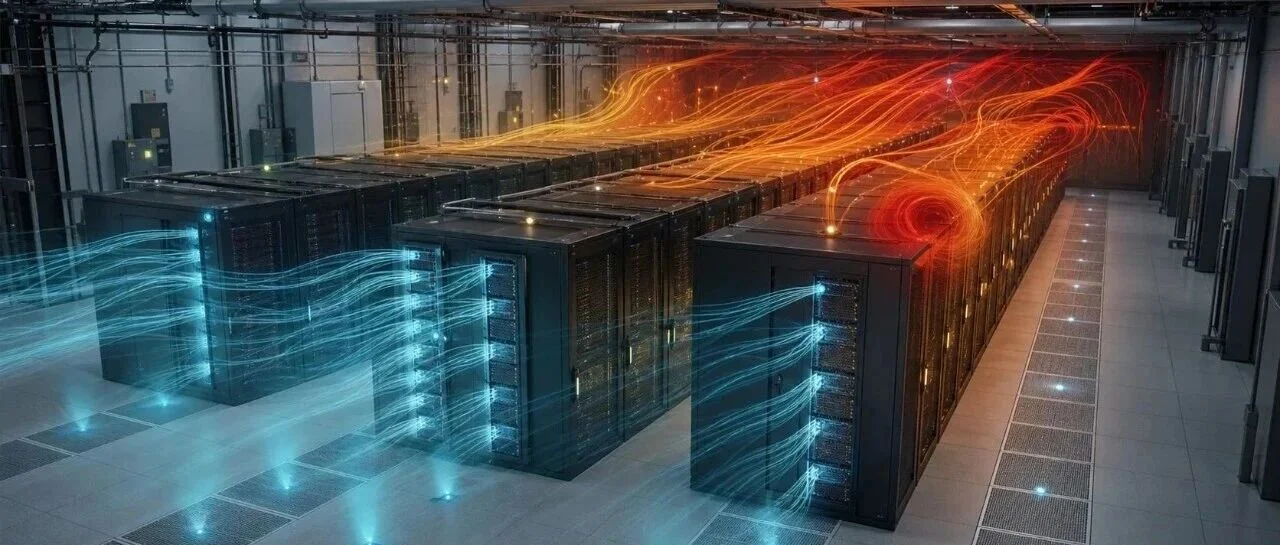
When AI enters an industrial facility, it has to work with more than documents and sensor tables. Air moves through rooms, heat travels between equipment, gases disperse through ventilation systems, and physical objects interact with machines. Decisions depend on understanding how those systems behave over time.
An industrial world model organizes the data, structure, and governing mechanisms of a facility into an environment that AI can query, calculate, and use to evaluate possible actions. DataMesh is developing this capability in FactVerse so industrial AI can work with repeatable operating context instead of isolated prompts and disconnected tools.
Three current application areas show why this matters:
- thermal airflow in data centers
- multi-species gas transport in semiconductor cleanrooms
- fluid-object interaction on manufacturing lines
From language models to industrial world models
A language model can explain common cooling principles. A site-specific decision requires much more context. In a data center, for example, an AI system may need to answer:
- Where will hot exhaust from this rack travel?
- How will a change in supply airflow affect inlet temperature across the room?
- Will an adjustment reduce recirculation, or move the problem to another row?
The answer depends on equipment position, geometry, supply and return conditions, current load, boundary conditions, and a suitable thermal-fluid model. An industrial world model brings these elements into one computational context.
Three layers of an industrial world model
Industrial data
Live telemetry, historical trends, alarms, work orders, maintenance records, process parameters, and simulation results describe the current and past state of a facility.
Industrial structure
Spatial coordinates, asset hierarchies, piping and electrical topology, upstream and downstream relationships, and production flows establish what each value belongs to and how objects affect one another.
Industrial mechanisms
Conservation of mass, momentum, and energy provides the physical foundation. Equipment logic, control strategies, process constraints, and safety rules add the operating mechanisms required for a specific facility.
A 3D scene can carry this information when each object has identity, attributes, relationships, state, and physical behavior. The result supports questions about current conditions and allows teams to calculate how a proposed change may alter future conditions.
FactVerse as an industrial AI execution harness
AI Agents commonly connect a foundation model to databases, APIs, scripts, and simulation tools. Industrial work adds requirements around units, versions, permissions, boundary conditions, execution order, and result validation.
In AI engineering, a harness is the execution framework around the model and its tools. It manages context, state, tool permissions, workflow order, error handling, validation, and process records. The model interprets the problem and selects actions; the harness keeps those actions inside an explicit engineering process.
FactVerse provides this role for the industrial world model by organizing a consistent world state and a repeatable execution path:
- Resolve a question to the relevant facility, system, asset, and time range.
- Retrieve the required data, physical model, parameters, and boundary conditions.
- Call query, simulation, analysis, and workflow tools in a defined sequence.
- Check units, versions, data completeness, conservation relationships, and solver status.
- Record inputs, execution steps, and outputs for comparison, review, and audit.
This structure makes results reproducible within a defined scenario, allows the workflow to be adapted to another facility by replacing its geometry and parameters, and helps engineers locate whether a failure originated in data, model configuration, or tool execution.
Physics gives AI a way to test consequences
Data-driven world models can rapidly predict candidate outcomes from video and sensor histories. Industrial decisions also have to satisfy physical and operating constraints. Changes to airflow, pressure, temperature, equipment position, or process timing need to be evaluated against the mechanisms governing the facility.
DataMesh uses a hybrid workflow:
- physics-based solvers calculate and validate high-value scenarios
- operational data calibrates parameters and boundary conditions
- data-driven surrogate models screen larger sets of alternatives
- AI Agents organize the question, invoke the right tools, and compare results
For gas and thermal transport, DataMesh has developed Lattice Boltzmann Method (LBM) capabilities for airflow, heat transfer, and multi-species transport. The solver is connected with FactVerse and NVIDIA Isaac Sim as a physics capability that can be called from an industrial workflow.
Why LBM is becoming practical for industrial simulation
LBM represents fluid behavior through distributions moving and colliding on a regular lattice. Its local, highly parallel computation and predictable memory access suit modern GPUs. Industrial CAD, BIM, scan data, and OpenUSD scenes can also be prepared as voxel or lattice domains, reducing part of the setup work required for complex facilities.
In one current DataMesh validation case, a consumer GPU simulated approximately 55 seconds of cleanroom gas transport in about one minute using roughly 1.78 million lattice cells. Runtime and accuracy vary with geometry, resolution, physics configuration, hardware, and convergence requirements, so each production workflow requires engineering calibration and validation.
The mathematical foundation continues to advance as well. The International Mathematical Union recognized 2026 Fields Medalist Yu Deng for work that includes the rigorous derivation of the Boltzmann equation from hard-sphere dynamics for rarefied gases. This research concerns the theoretical bridge between particle dynamics and kinetic descriptions; LBM turns a related mesoscopic representation into a computational method suited to parallel hardware.
Three industrial scenarios
Data centers: tracing heat and airflow
Monitoring systems can identify a rack with high inlet temperature. A thermal world model adds spatial airflow and heat transport so engineers can examine why the condition occurred and compare corrective options.
In one validation scenario, a meaningful share of the air entering the worst-performing rack came from recirculated exhaust generated by the rack itself and neighboring equipment. The analysis helped distinguish a recirculation path from a simple shortage of supply air, giving engineers a clearer basis for reviewing containment, airflow, and layout options.
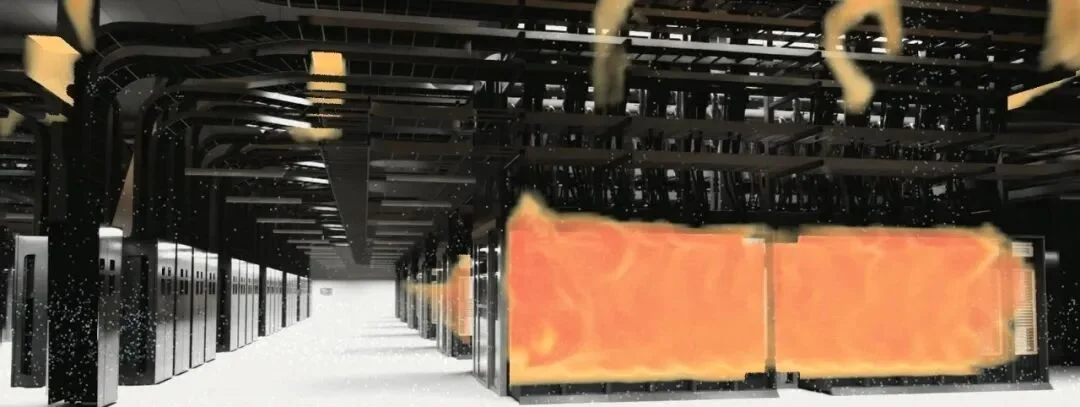
Semiconductor cleanrooms: modeling gas transport and detection
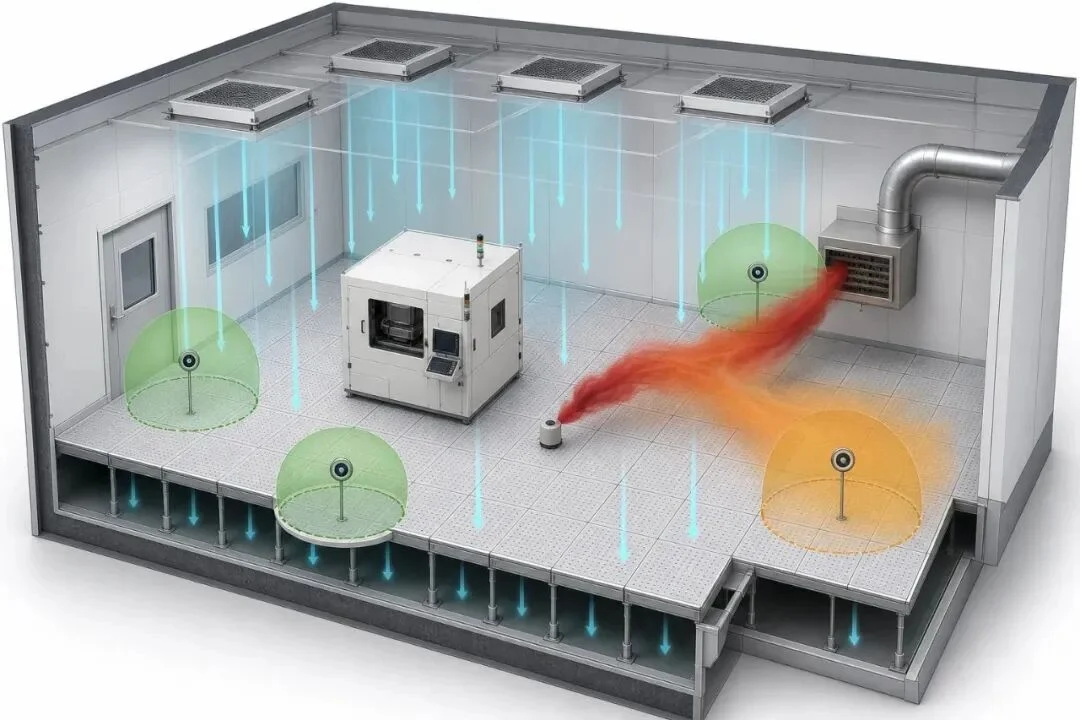
Cleanroom safety analysis needs to understand where a hazardous release may travel, how concentration changes over time, when detectors may respond, and whether ventilation conditions create persistent coverage gaps.
Simulation can reveal behavior that timing alone may hide. In some scenarios, simultaneous loss of ventilation and capture can produce an earlier detector alarm because dilution and removal both decrease. Engineering review therefore considers concentration fields, exposure zones, detector coverage, and system state together.
Manufacturing lines: coupling fluids with moving objects
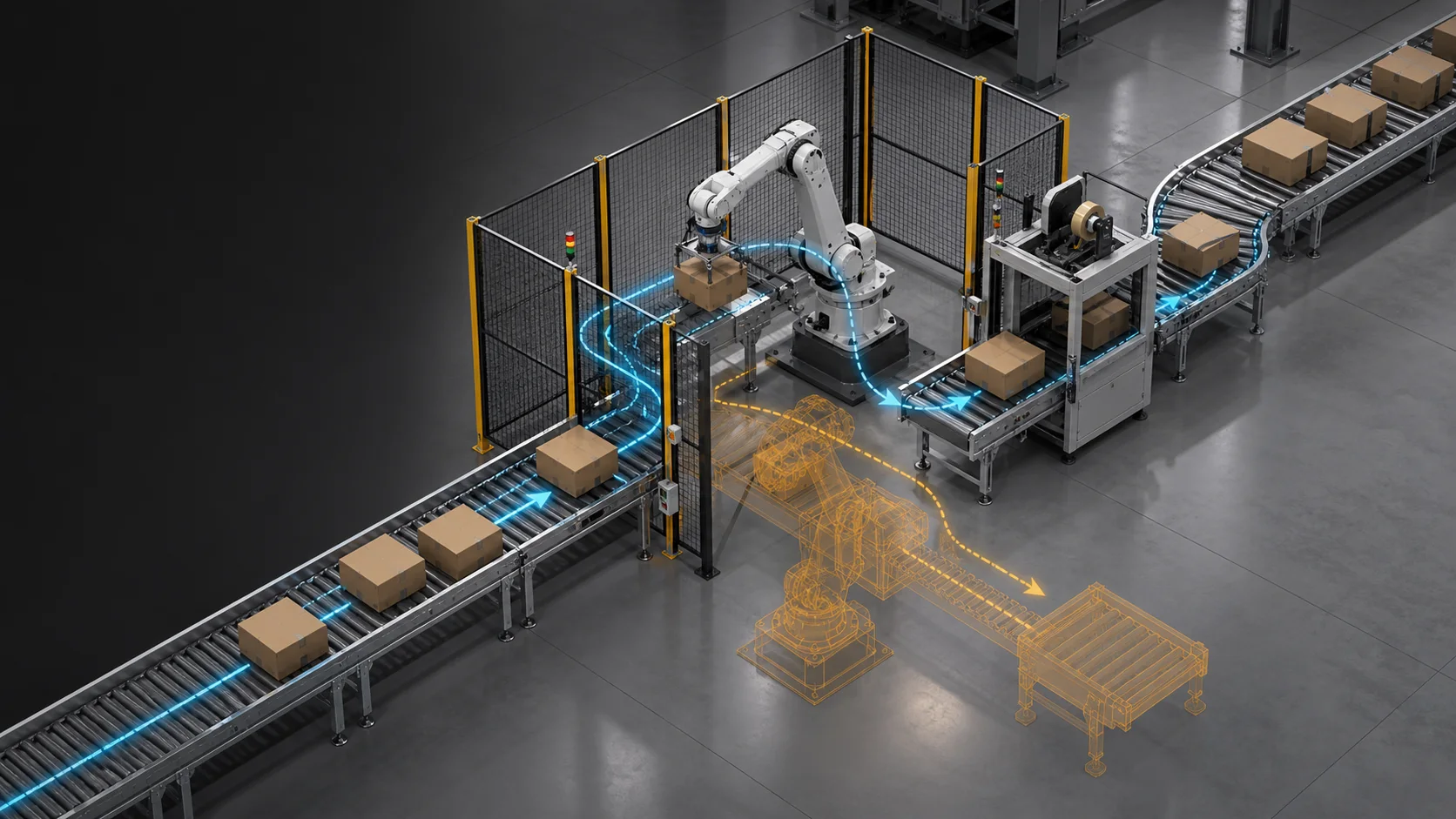
On high-speed production equipment, jets and pressure fields can move, rotate, or obstruct parts. DataMesh is validating coupled workflows in which a fluid field applies forces to rigid bodies, while object position and orientation alter the local flow. Collision, friction, material parameters, and machine timing become part of the same scenario.
This capability supports the next stage of process simulation for part transport, packaging, robotic handling, and abnormal-jam analysis. It also gives Physical AI systems a richer environment for learning how actions interact with real operating constraints.
From a solver run to a repeatable AI workflow
The long-term value comes from making simulation part of a governed operating loop. FactVerse can prepare a scene, bind current facility data, configure a solver, preserve provenance, and return results to FactVerse AI Agent for comparison and review.
Teams can use this workflow to:
- generate candidate rack layouts, detector placements, ventilation settings, or production parameters
- run batches of simulations under defined conditions
- rank alternatives using engineering criteria
- bring a smaller set of candidates forward for engineering approval
Operating data can then refine parameters and boundary conditions over time.
Trustworthy use depends on:
- clear model ownership
- verified geometry and sensor data quality
- versioned boundary conditions
- documented assumptions
- solver calibration and validation
- uncertainty review
- human approval for operational changes
These controls make simulation evidence understandable and reusable across planning, incident review, and continuous improvement.
A computational foundation for Physical AI
Data describes industrial state. Structure establishes relationships. Physics calculates change. FactVerse brings these layers into a repeatable environment that AI can inspect and operate through governed tools.
This is the direction of the industrial world model: a shared computational environment for facility operations, engineering simulation, AI decision support, and Physical AI development. Explore the DataMesh Physical AI platform, data center operations, semiconductor facility operations, and physics-based process simulation.