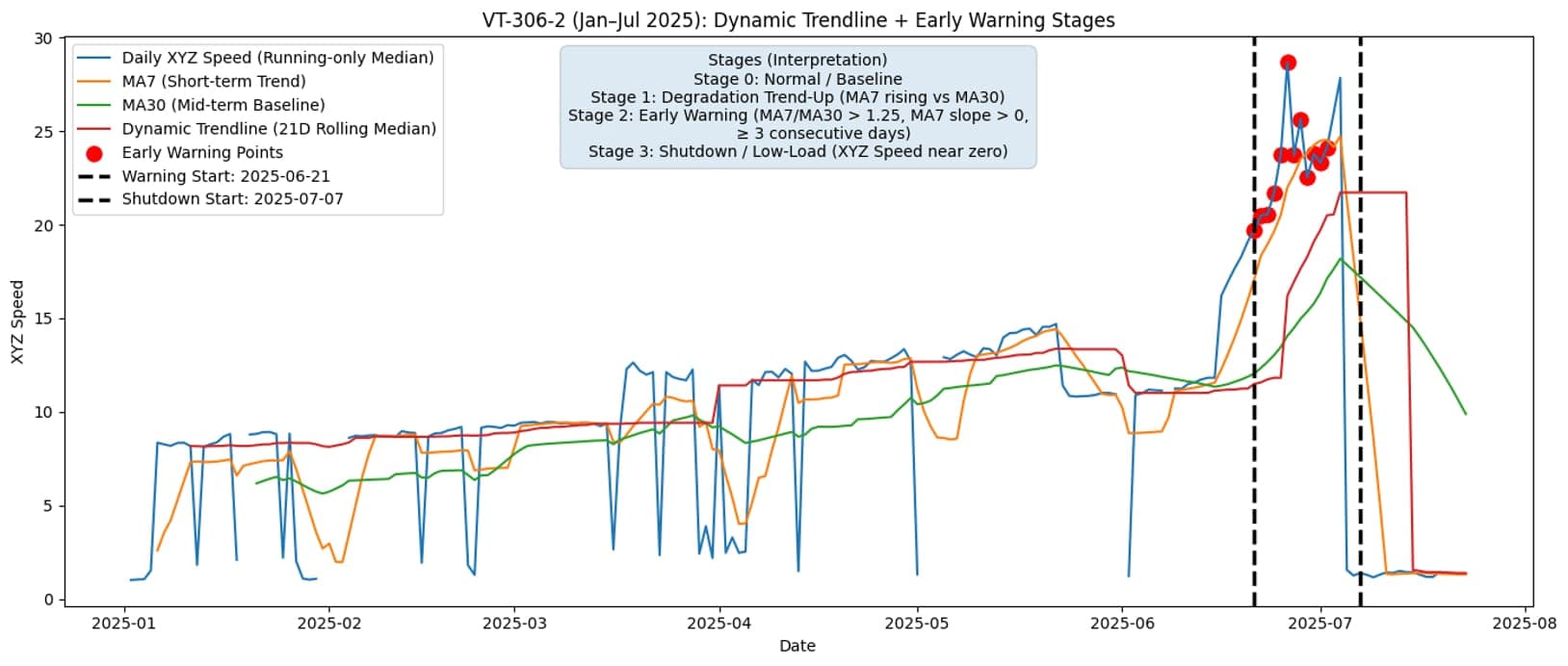
The maintenance loop starts after the signal
Predictive maintenance becomes useful when a risk signal can move into a disciplined work process. A vibration trend, temperature drift, current anomaly, or repeated alarm should lead to a reviewable question: which asset is affected, how credible is the finding, what else is connected to the asset, which team should review it, and what field action should follow.
DataMesh Predictive Maintenance uses a digital twin to connect those steps. Data, asset context, AI-assisted review, work orders, field evidence, and verification stay in one operating loop so maintenance teams can learn from every decision.
This is also a practical Physical AI workflow. AI helps interpret real-world signals, and the digital twin keeps the recommendation grounded in equipment, location, system relationships, and site-approved execution.
What the loop needs
A closed-loop maintenance workflow usually needs these layers:
- Connected signals: vibration, temperature, current, pressure, runtime, alarms, historian tags, and environmental context.
- Asset context: equipment hierarchy, location, operating role, system dependencies, maintenance plan, documents, and spare-part context.
- AI-assisted review: trend comparison, anomaly review, likely degradation patterns, evidence summaries, and recommendation drafting.
- Twin-based validation: spatial context, upstream and downstream dependencies, recent work, operating constraints, and field accessibility.
- Work execution: Inspector work orders, Checklist tasks, assignment, field notes, photos, acceptance, and closure status.
- Follow-up evidence: post-maintenance readings, repeat alarm review, condition comparison, and updated asset history.
The goal is a maintenance record that explains what was detected, why it mattered, who reviewed it, what action was approved, and how the outcome was verified.
Role of the DataMesh stack
Data Fusion Services connects sensors, historians, BMS, SCADA, CMMS, EAM, IoT, and enterprise systems. It prepares operational data for digital twin binding, analytics, and AI review.
FactVerse AI Agent provides the decision intelligence layer. The FactVerse AI Agent predictive maintenance module reviews signal behavior, asset relationships, maintenance history, and operating context, then prepares evidence and recommended actions for maintenance teams.
FactVerse and the digital twin context help teams see where the asset sits, what systems it supports, and which dependencies matter. Inspector manages inspections, work orders, field records, verification, and maintenance evidence. Checklist helps consolidate tasks and recurring work across teams.
Customer-governed systems such as CMMS, EAM, BMS, SCADA, and site approval workflows can remain the operational systems of record where the organization defines that ownership.
Signal to verified work
A practical workflow can be implemented in six steps:
- Connect sensor, historian, alarm, inspection, and asset data.
- Map assets, systems, points, and work records into the digital twin.
- Use FactVerse AI Agent to review trends, abnormalities, and related evidence.
- Let maintenance and engineering teams confirm the finding in twin context.
- Create an Inspector work order or Checklist task with clear scope, owner, and acceptance criteria.
- Capture completion evidence and compare the post-work condition with the original signal.
This workflow makes prediction actionable. The result is a traceable maintenance decision with field context, ownership, and completion evidence.
Where to apply it first
| Starting point | Practical focus |
|---|---|
| Rotating equipment | Pumps, compressors, motors, fans, and other assets with vibration, temperature, current, or pressure patterns |
| Facility utility systems | HVAC, chilled water, compressed air, power distribution, and other systems with recurring alarms or service history |
| Production support assets | Conveyors, robotic cells, fixtures, and handling equipment where maintenance timing affects production flow |
| Inspection-heavy assets | Assets with frequent rounds, recurring issues, or inconsistent field records |
| Multi-site operations | Shared asset classes where lessons from one site can improve review patterns across other sites |
The first pilot should have useful data history, a maintenance owner, a manageable asset scope, and a field team ready to close the loop.
Data readiness checklist
Before rollout, review these conditions:
- Sensor signals have stable identifiers, timestamps, units, and asset mapping.
- Maintenance history is available at asset or equipment-group level.
- Work orders have enough detail to understand cause, action, and closure.
- Asset hierarchy and location data can be linked to the digital twin.
- Engineering and maintenance teams agree on review, approval, and escalation rules.
- Field teams can capture evidence in a structured way.
- Pilot metrics are tied to verified operating records.
Data quality work at this stage is part of the predictive maintenance program. It determines which assets are ready for AI-assisted review and which systems need cleanup first.
Metrics to validate
Predictive maintenance value should be measured with the site's own baseline. Useful metrics include:
- Time from signal detection to human review.
- Share of findings that become planned maintenance.
- Work-order closure quality and evidence completeness.
- Repeat alarms after corrective work.
- Asset condition trend after maintenance.
- Field team response time and task acceptance quality.
- Engineering review effort for recurring asset classes.
Savings claims need validation against each site's own baseline, asset scope, and operating history. A practical validation plan keeps assumptions, baseline data, and closed-loop results traceable from pilot through rollout.
Public references
The Yokogawa and DataMesh announcement shows the public direction for AI-driven predictive maintenance in industrial facilities, especially for critical rotating equipment.
The Swire Coca-Cola and Foxconn references show how maintenance process digitization, frontline guidance, and training can support the execution side of the loop.
For buyers, the important pattern is clear: predictive maintenance needs connected signals, trusted asset context, AI-assisted review, and work execution records that preserve what happened in the field.