Facility management needs one operating context
Large facilities are managed through many specialized systems. BMS, EMS, meters, alarms, asset registers, CMMS, EAM, BIM, drawings, service reports, and inspection records each describe part of the site. The daily challenge is connecting those parts when an issue appears, a work order is created, an energy pattern changes, or a manager asks for evidence.
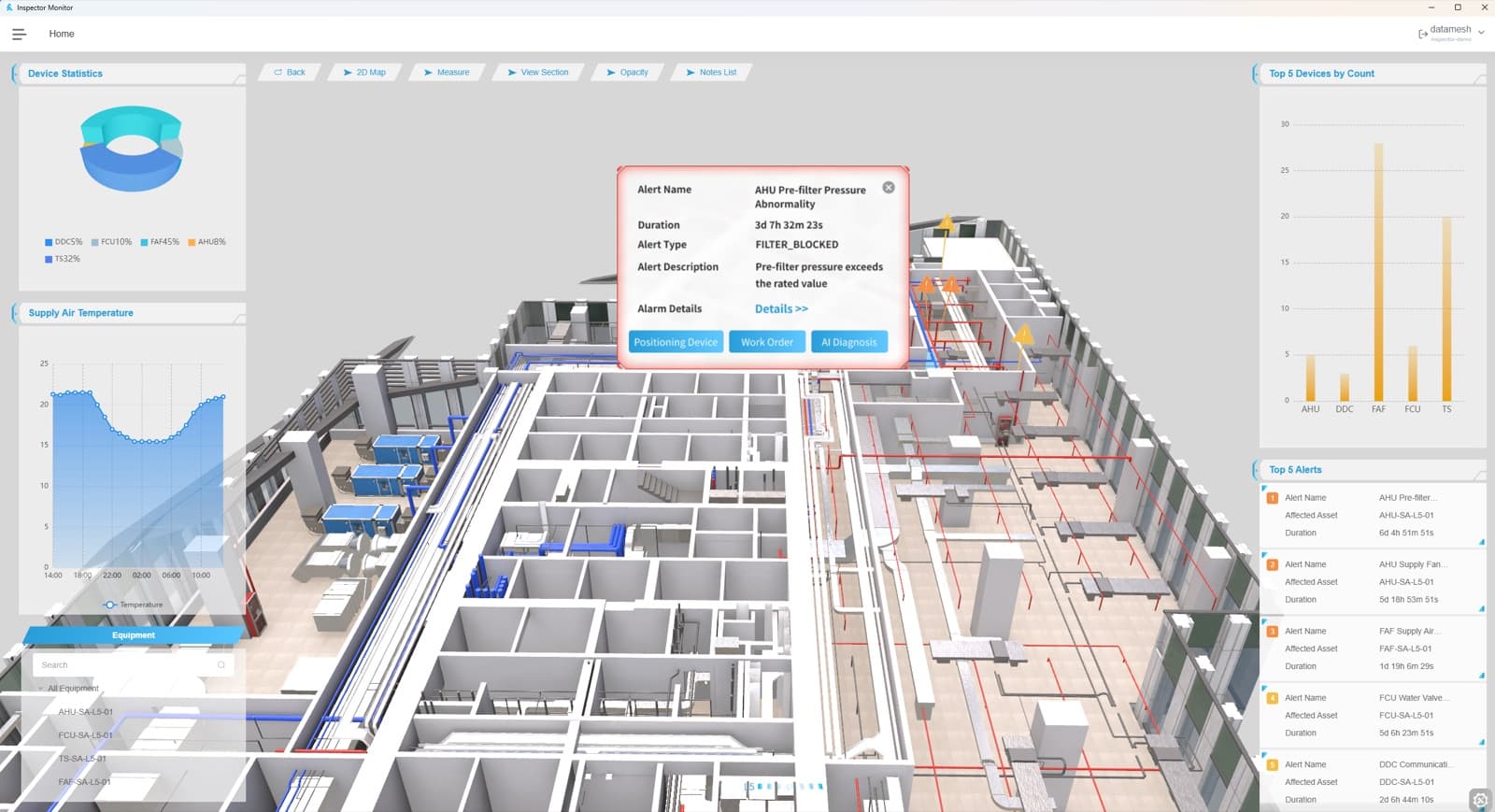
AI facility management starts with an operational digital twin. The twin connects spaces, assets, systems, data, work records, documents, and field execution so teams can review facility conditions in context. AI then helps summarize abnormalities, compare patterns, draft recommended actions, and prepare management review.
This pattern is useful for commercial buildings, campuses, data centers, plants, utilities, and high-tech manufacturing facilities. In advanced manufacturing programs, facility teams often need to manage cleanroom support systems, power, compressed air, cooling, exhaust, alarms, inspections, and service handoffs across multiple sites. A shared twin gives those teams a stable context for review and execution.
What the facility twin should connect
| Layer | Operating context |
|---|---|
| Spaces | Site, building, floor, room, zone, clean area, service corridor, access route, and safety boundary |
| Systems | HVAC, cooling, power distribution, lighting, water, compressed air, exhaust, fire safety, elevators, and process utilities |
| Assets | Equipment registry, asset IDs, documents, service owner, maintenance plan, warranty context, and spare-part references |
| Signals | BMS points, meters, sensors, alarms, environmental readings, historian tags, and calculated indicators |
| Work | Inspections, work orders, corrective actions, photos, field notes, acceptance records, and verification status |
| Energy | Meter readings, EUI, load composition, operating hours, weather context, setpoints, and improvement options |
| Semantics | Brick Schema-aligned buildings, systems, equipment, meters, sensors, points, and relationships |
| Governance | Source owner, data quality, approval route, operating responsibility, version, and evidence retention |
The twin becomes useful when a signal can be traced to the affected space, asset, system, responsible team, and field record.
DataMesh workflow for AI facility management
- Collect facility sources - Bring together BMS, EMS, meters, IoT, historians, asset registers, CMMS, EAM, BIM/IFC, drawings, inspection plans, and service reports.
- Build the operating twin - Use FactVerse and Twin Engine to organize spaces, assets, utility systems, documents, routes, points, and work context.
- Connect data pipelines - Use Data Fusion Services to ingest, clean, normalize, compute, and bind operating data to the correct twin objects.
- Structure facility semantics - Use Brick Schema-aligned relationships where useful so buildings, zones, equipment, meters, sensors, and points have consistent meaning.
- Review with AI assistance - Use FactVerse AI Agent to summarize abnormal consumption, repeated alarms, missing records, maintenance patterns, and candidate actions for human review.
- Compare energy scenarios - Use EnergyPlus-based workflows where deeper building energy modeling and scenario comparison are needed.
- Execute and verify work - Use Inspector to create inspections, work orders, assignments, photos, repair notes, acceptance records, and verification evidence.
The result is a closed operating loop from signal to analysis, from analysis to work, and from work to verified record.
Where AI adds value
AI is most useful when the facility context is already connected. FactVerse AI Agent can help teams review large amounts of operating data and work history faster than dashboard-by-dashboard inspection.
Useful review patterns include:
- Repeated alarms by space, system, asset, time window, and work history.
- Abnormal energy use by meter, zone, asset group, weather, and operating schedule.
- Maintenance-prone assets with recurring repairs, incomplete records, or repeated acceptance failures.
- Cleanroom or controlled-area drift that needs facility, utility, and maintenance context.
- Work-order backlog patterns across sites, service teams, and asset classes.
- Improvement candidates that need engineering review, cost context, and field validation.
The practical role of AI is decision support. Facility teams still need responsible owners, approval rules, field execution, and verification evidence.
Brick Schema and EnergyPlus in the same workflow
Brick Schema gives building and facility data a consistent semantic layer. A temperature point can be connected to the right sensor, zone, air system, and equipment. A meter can be connected to the system or space it measures. A work order can be connected to the asset, alarm, document, and inspection that triggered it.
That semantic layer improves traceability for maintenance, energy analysis, Green Mark readiness, and management review. It also gives AI Agent better context when it summarizes issues or prepares recommended actions.
EnergyPlus fits when the team needs deeper energy analysis. DataMesh can connect BIM/IFC, weather data, operating records, and digital twin context with EnergyPlus-based building energy models to compare EUI, load composition, operating schedules, setpoints, retrofit options, and control strategy changes.
These analysis outputs should flow back into the operating loop. The team can create work orders, record assumptions, capture field results, and compare the post-action operating record against the baseline.
Where to start
Good first scopes are areas where facility data, asset ownership, and work execution already exist:
- Utility systems with repeated alarms or unclear service ownership.
- HVAC and cooling systems with energy or comfort review needs.
- Cleanroom support systems where environmental drift and maintenance records need shared context.
- Meter groups and high-load zones used for energy governance.
- Inspection-heavy equipment with recurring field records.
- Multi-site facility portfolios that need comparable asset classes and reports.
Start with a pilot that connects a manageable asset group, one or two source systems, a clear work-order path, and review metrics that the facility team already trusts.
Metrics to validate
AI facility management should be validated against the site's own baseline. Useful measures include:
- Time from alarm or finding to review.
- Share of findings converted into planned work.
- Work-order closure quality and evidence completeness.
- Repeat alarm rate after corrective work.
- Energy baseline completeness and review frequency.
- Data mapping coverage for priority assets and systems.
- Field team acceptance of guided procedures and record capture.
- Management review quality across sites, assets, and service teams.
The strongest programs measure work quality and decision traceability before they claim savings.
Public references
The JTC and DataMesh collaboration shows digital twin and mixed reality used around complex facility and construction workflows.
The Yokogawa predictive maintenance reference shows the public direction for AI-assisted maintenance review in industrial facilities.
The Swire Coca-Cola maintenance reference shows how frontline training, maintenance process digitization, and field records support execution.
The Faurecia and EVE Energy reference shows how operational visibility, energy context, and digital twin workflows can support manufacturing and facility improvement programs.