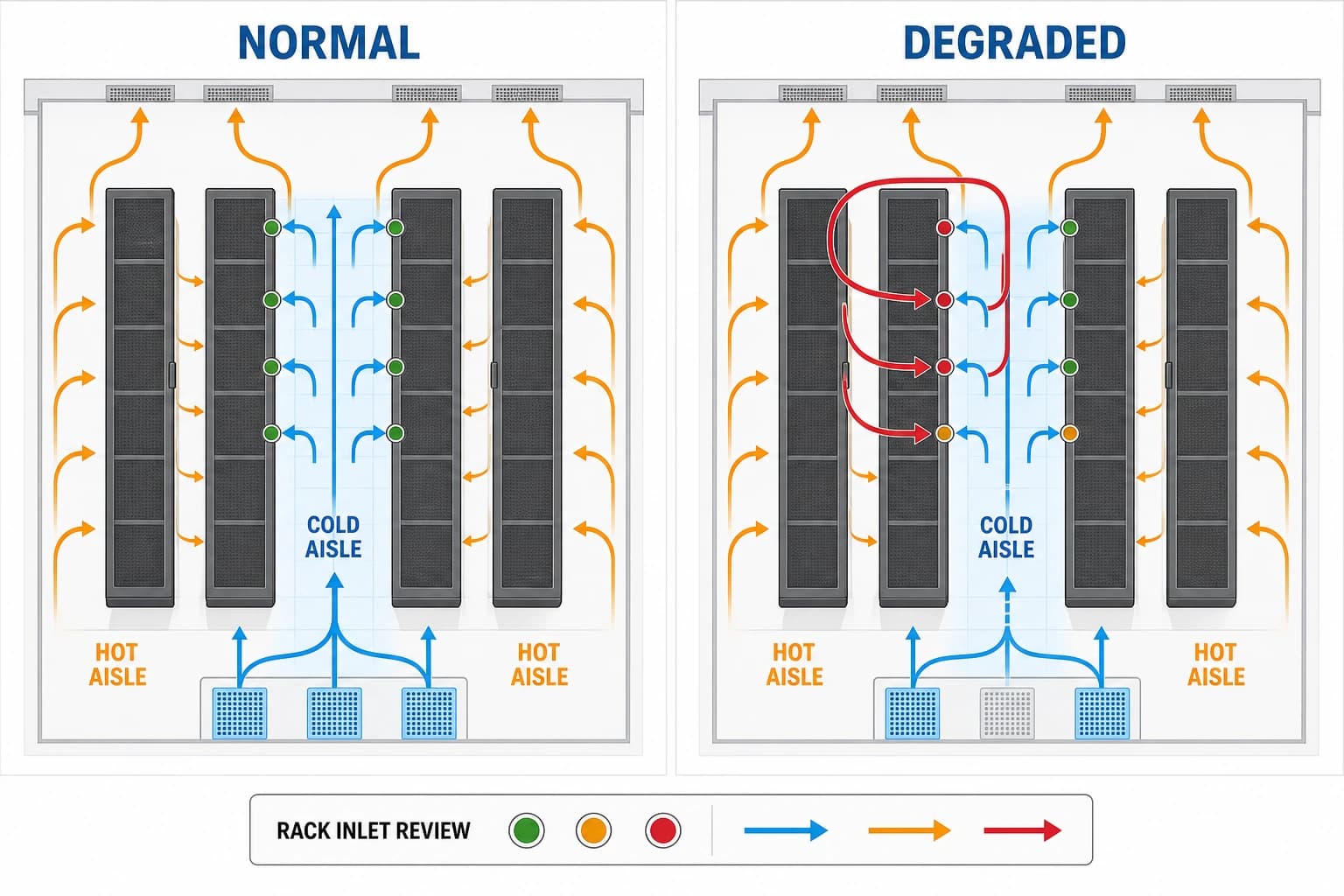
Thermal risk becomes operational at the rack inlet
Data center teams often have room temperatures, cooling-unit readings, alarms, rack inventories, and power data in separate systems. A room average can look stable while a small group of racks receives warmer recirculated air or less airflow. That local condition can narrow operating margin, constrain the next capacity change, and raise the urgency of a cooling or containment review.
The rack inlet gives buyers a practical observation point. It connects the cooling air delivered by the facility with the environment experienced by information technology equipment. The American Society of Heating, Refrigerating and Air-Conditioning Engineers (ASHRAE) established equipment inlet conditions as a common basis for data center environmental guidance. Equipment class, manufacturer requirements, site policy, humidity, operating mode, and the current guidance still determine the accepted envelope for a specific facility.
An effective assessment answers four questions:
- Which racks or inlet positions are closest to the agreed limit?
- Is the condition isolated, persistent, load-related, or linked to cooling distribution?
- How much thermal margin remains under the reviewed operating state?
- Which measurement, engineering, or operational action should follow?
Define the decision before choosing the analysis
A useful thermal study starts with a decision. Examples include approving a rack-density increase, reviewing a recurring hot spot, comparing containment options, preparing for a cooling-unit maintenance window, or selecting locations for additional sensors.
The decision defines the necessary evidence:
| Decision | Evidence focus | Useful output |
|---|---|---|
| Investigate a current hot spot | Recent inlet measurements, rack load, cooling state, alarms, containment, and field observations | Affected racks, likely dependencies, data gaps, and inspection priorities |
| Review a load increase | Proposed rack loads, airflow demand, cooling distribution, operating envelope, and representative boundary conditions | Baseline and proposed inlet conditions, remaining margin, and areas requiring engineering review |
| Compare containment changes | Geometry, openings, leakage paths, supply and return arrangement, rack airflow direction, and load distribution | Relative recirculation patterns, rack-level differences, and option trade-offs |
| Prepare for cooling maintenance | Cooling-unit availability, redundancy assumptions, current load, sensor evidence, and operating sequence | Expected affected zones, margin under the reviewed state, and monitoring priorities |
This decision-first approach keeps the work proportional. A sensor review may resolve a data-quality question. A spatial thermal model becomes valuable when the decision depends on airflow paths, uninstrumented locations, future loads, or conditions that are difficult to reproduce safely in the operating facility.
Build a trustworthy facility baseline
Thermal evidence depends on the quality of the facility model and operating inputs. Buyers should expect a clear record of what was provided, what was measured, what was inferred, and what remains uncertain.
Spatial and equipment context
- room, aisle, rack, raised-floor, ceiling, duct, opening, and containment geometry
- rack position, orientation, height, population, and equipment airflow direction
- cooling-unit location, capacity, supply and return arrangement, and operating state
- perforated tiles, grilles, dampers, barriers, leakage paths, and major obstructions
- sensor identity, location, mounting height, unit, calibration status, and ownership
Operating and thermal context
- representative rack or information technology load by time and operating state
- supply-air temperature, return-air temperature, flow, pressure, and fan information where available
- room temperature, humidity, rack-inlet measurements, alarms, and environmental records
- containment status, maintenance condition, active cooling units, and control settings
- outdoor or adjacent-space conditions when they influence the reviewed boundary
Governance context
- the equipment classes and manufacturer limits represented
- the customer-approved environmental envelope and measurement practice
- the time period and operating state covered by the evidence
- the decision owner, engineering reviewer, and acceptance criteria
Data Fusion Services can align equipment identities, timestamps, units, sensor quality, alarms, and engineering records. DataMesh FactVerse can organize the rooms, racks, cooling systems, sensors, and spatial relationships in an operational digital twin. This shared context makes measurements and model results traceable to the assets and locations under review.
Turn a thermal field into a rack-level decision
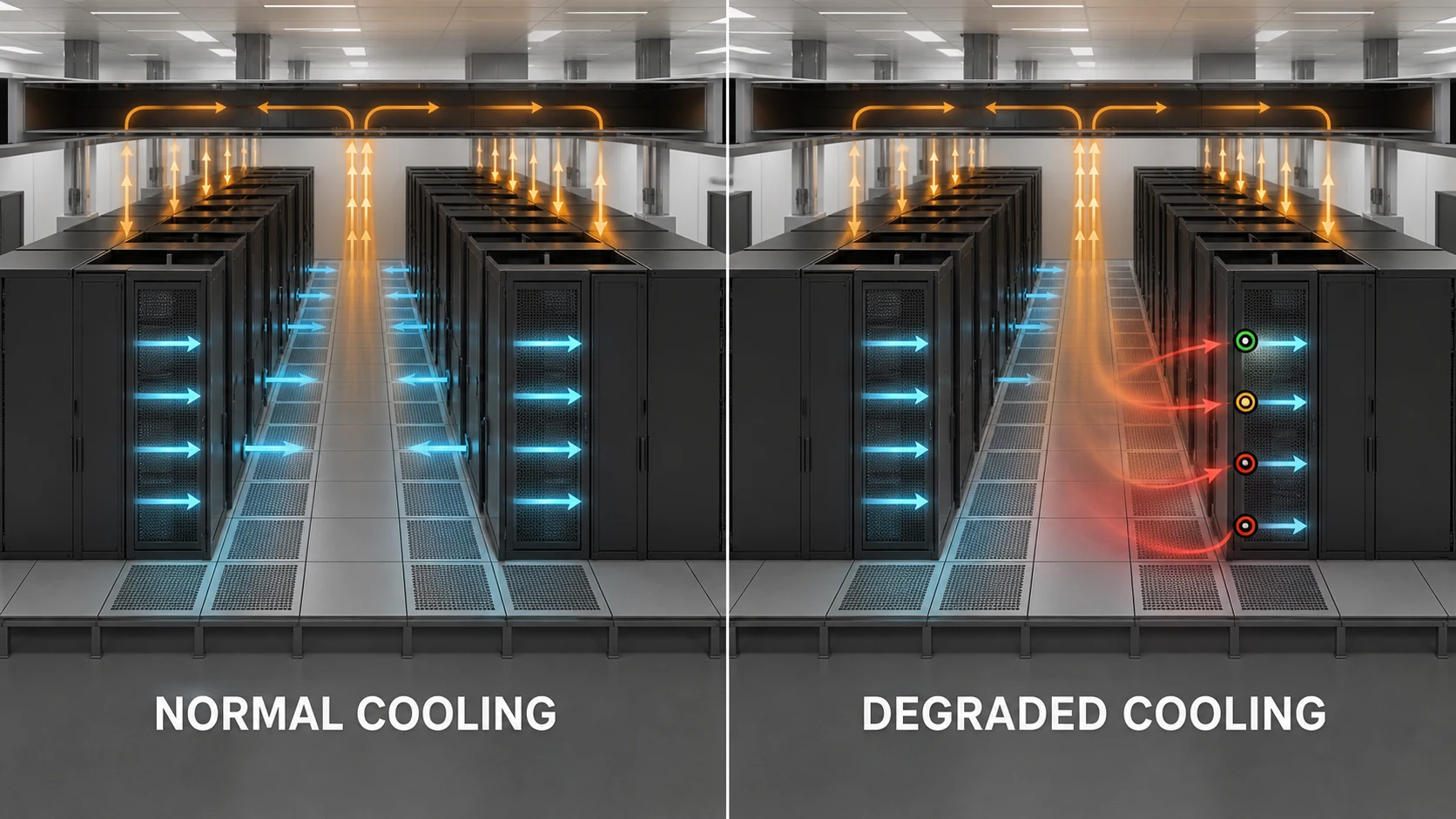
Rack-level review connects spatial airflow and temperature behavior with defined inlet positions, equipment limits, and operating decisions.
A thermal field shows how temperature and airflow vary through space. Buyers still need agreed metrics that translate the field into a reviewable decision. Useful metrics can include:
- inlet temperature at defined top, middle, and bottom positions
- maximum, percentile, or time-window inlet temperature for the reviewed condition
- number and location of inlet points approaching an agreed limit
- recirculation or bypass patterns that influence the affected racks
- difference between baseline and candidate scenarios
- persistence, rate of change, and sensitivity to load or cooling state
- remaining thermal margin by rack, zone, or equipment class
A simple margin definition is:
thermal margin = agreed rack-inlet limit - evaluated rack-inlet temperature
Every reported margin should identify the limit source. It should also state whether the evaluated temperature comes from a sensor, a calibrated simulation, an exploratory model, or a conservative scenario value. A two-degree margin has very different meaning when it comes from a single unverified sensor, a validated measurement set, or a model operating beyond its calibration range.
Separate live visibility from project-enabled thermal evidence
Live operations and thermal analysis answer related questions at different depths.
| Capability | Primary evidence | Questions it supports |
|---|---|---|
| Live operational visibility | Connected sensors, meters, equipment states, alarms, asset records, inspections, and work history | What is happening now, where is the alarm, which asset is affected, and who owns the response |
| Project-enabled thermal analysis | Reviewed geometry, rack loads, cooling conditions, boundary assumptions, available measurements, solver checks, and an evidence package | How airflow and temperature may vary across space, what may happen under a proposed change, and which areas deserve qualified review |
FactVerse AI Agent can help operations teams relate abnormal trends, alarms, asset history, and maintenance context. A project-enabled thermal workflow adds spatial fields and scenario comparison when a capacity, cooling, or layout decision requires them. Inspector can carry an approved finding into field inspection, work execution, and verification.
Use the right operating envelope
ASHRAE guidance distinguishes recommended and allowable environmental envelopes for classes of data communication equipment. Manufacturers may define additional configuration-specific limits, and each operator may adopt site standards based on reliability objectives, measurement methods, equipment mix, and operating conditions.
For buyer evaluation, the project should record:
- the equipment population and environmental class under review
- the applicable ASHRAE guidance edition and table or process used
- manufacturer requirements for the installed configuration
- the customer-approved normal, alert, and engineering-review thresholds
- the humidity and measurement conditions associated with those thresholds
- how transient excursions and data gaps are handled
This creates a stable basis for calculation while allowing the site to evolve as equipment and guidance change.
Match confidence to calibration evidence
An exploratory model can show directional patterns and compare options under stated assumptions. A benchmarked model adds reference cases and solver checks. A measured-data calibrated model compares relevant outputs with representative site observations. A scenario-specific validated study adds independent evidence under the conditions needed for the intended decision.
For rack-inlet work, useful calibration evidence can include multiple inlet locations, representative loads, stable and transition periods, active cooling states, and a separate condition or time period reserved for validation. Reviewers should see residuals by location and operating state, along with sensor uncertainty and known mismatches.
The calibration and simulation confidence guide explains how to match claim strength to the available proof. The scenario ensemble guide shows how to compare plausible ranges when loads, equipment states, or boundary conditions vary.
Buyer checklist
Decision and scope
- Is one operational, capacity, resilience, or layout decision clearly named?
- Are the racks, zones, operating states, and time horizon defined?
- Is the consequence of a narrow or negative margin understood?
Data and model readiness
- Are rack geometry, airflow direction, load, and equipment limits available?
- Are cooling layout, active state, supply, return, containment, and openings represented?
- Can every sensor value be traced to an identity, location, timestamp, unit, and quality status?
- Are assumptions and missing evidence visible to the reviewer?
Evidence and acceptance
- Is the source of each operating limit recorded?
- Are measured and simulated values clearly identified?
- Are residuals, uncertainty, and sensitivity shown at decision-relevant locations?
- Does the claimed confidence stay within the documented evidence envelope?
Action and ownership
- Is each finding linked to the affected room, rack, cooling asset, or sensor?
- Is a qualified reviewer responsible for the conclusion?
- Can approved actions enter inspection, maintenance, or change-management workflows?
- Is post-change verification part of the handover plan?
Scope a focused pilot
A practical pilot can begin with one representative room or aisle and one decision. The team selects a manageable rack population, verifies asset and sensor context, defines the approved operating envelope, and captures a representative baseline. A candidate load, containment, cooling, or monitoring change can then be compared under agreed evidence and review criteria.
Pilot success criteria can include:
- verified geometry, rack identity, load, cooling state, and sensor mapping
- a reproducible baseline with documented inputs and checks
- rack-level measurements and residual review appropriate to the intended claim
- a thermal-margin view tied to the approved limit source
- a scenario comparison that changes a real planning or inspection decision
- named engineering ownership and a reusable evidence package
Explore Data Center Operations for the complete workflow across operational visibility, thermal assessment, maintenance execution, and multi-site context. The broader simulation evidence evaluation guide provides a procurement checklist for reviewing methods, models, uncertainty, and handover evidence.
Continue with Cooling-Failure Scenario Analysis to review degraded and unavailable cooling states, then use Load Growth and Capacity What-If Analysis to compare proposed rack, load, cooling, containment, and layout changes.
Public references
The ASHRAE Data Centers and Telecommunications Facilities handbook chapter describes equipment inlet temperature as the common environmental reference point and explains the role of recommended and allowable ranges.
ASHRAE's article on high reliability and energy efficiency in data center design and operations introduces the fifth edition of Thermal Guidelines for Data Processing Environments and its role in aligning facility operations with equipment requirements.
The United States Department of Energy Best Practices Guide for Energy-Efficient Data Center Design covers information technology environmental conditions, air management, cooling systems, and measures that reduce warm-air recirculation around rack intakes.