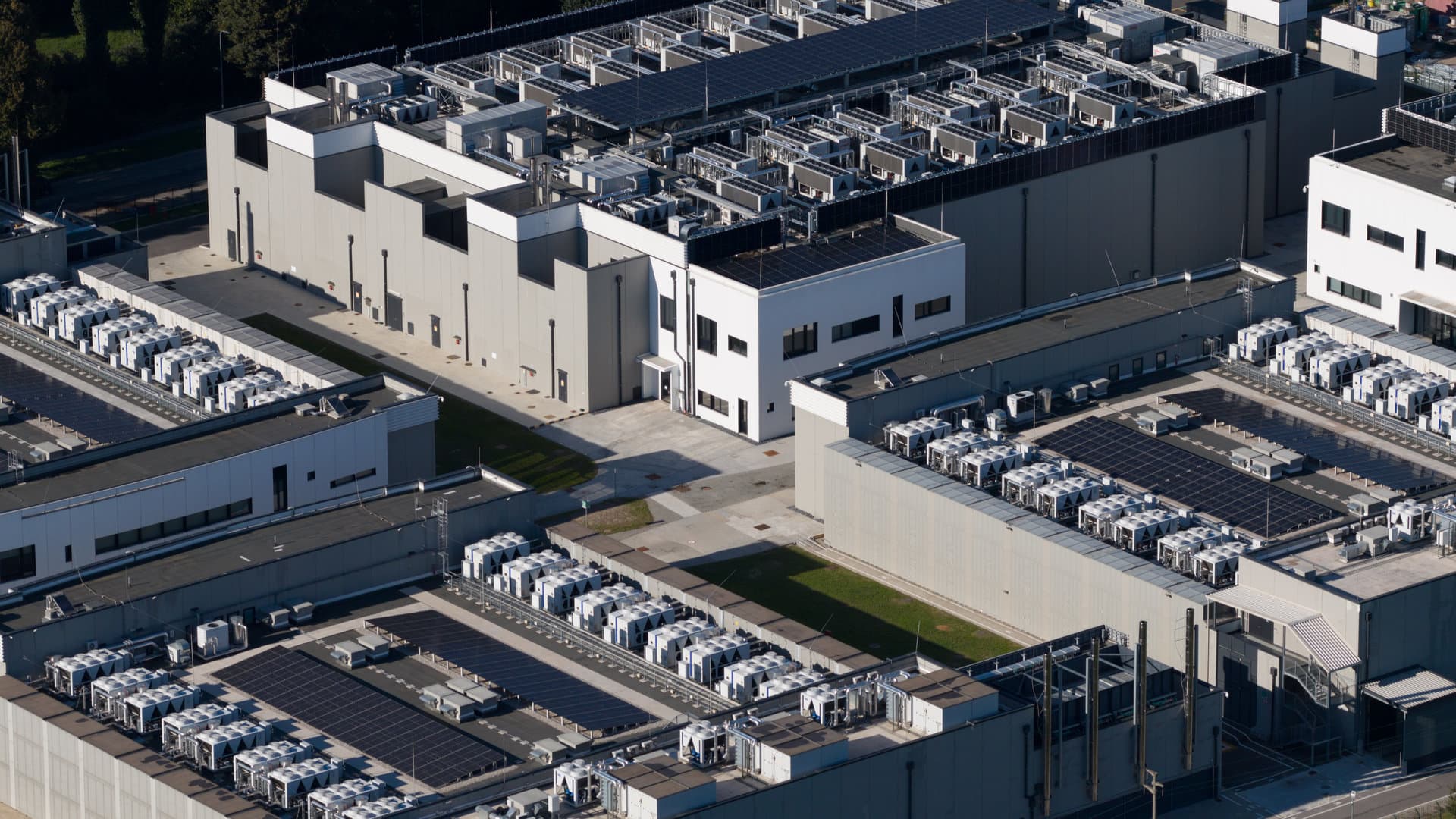
Capacity confidence depends on location and operating state
A data center can have available electrical or nameplate cooling capacity while a proposed rack placement creates a local airflow or temperature constraint. Capacity planning therefore needs more than a site-level total. Teams need to understand where load will be added, how air reaches the equipment, which cooling paths serve the area, what redundancy state is assumed, and how much rack-level thermal margin remains.
A project-enabled what-if study creates a common basis for comparing alternatives before procurement, installation, or room modification. It helps capacity, facility, information technology, and operations teams review the same geometry, load assumptions, cooling conditions, evidence, and acceptance criteria.
The purpose is practical: choose a stronger option, identify evidence gaps early, and reduce avoidable field rework.
Start from a verified operating baseline
Every candidate scenario should be compared with the same verified baseline. The baseline describes the facility and operating state represented by the study.
Facility baseline
- room, pod, aisle, rack, containment, floor, ceiling, duct, grille, and opening geometry
- rack identity, position, orientation, equipment population, and airflow direction
- cooling equipment, supply and return paths, controls, active state, and observed performance
- power and cooling dependencies relevant to the reviewed capacity zone
- current asset, maintenance, inspection, and change history
Load and environmental baseline
- connected, measured, and representative information technology load by rack and time period
- diversity, utilization, growth, and transition assumptions
- supply, return, flow, pressure, rack-inlet temperature, humidity, and equipment-state evidence
- containment condition, leakage, obstruction, temporary equipment, and floor-tile or grille configuration
- approved operating envelope by equipment class or rack population
Evidence baseline
- sensor identity, location, unit, timestamp, calibration status, and data quality
- model version, geometry source, parameter source, and boundary conditions
- benchmark, calibration, residual, validation, and sensitivity records
- the intended decision, reviewer, acceptance criteria, and revalidation triggers
Data Fusion Services can align load, meter, sensor, alarm, asset, and maintenance evidence across source systems. DataMesh FactVerse gives the baseline spatial and system context. FactVerse Designer supports prepared scenes, layouts, scenarios, and engineering review context for project-enabled analysis.
Change one scenario family at a time
Scenario design should make differences easy to explain. A useful family varies selected inputs while keeping the rest of the comparison basis stable.
| Scenario family | Variables to compare | Typical decision |
|---|---|---|
| Rack load growth | Load per rack, load distribution, diversity, utilization, and transition timing | Approve a new workload or define a staged rollout |
| Rack density and placement | Rack population, equipment type, airflow direction, location, and spacing | Select racks or positions for higher-density equipment |
| Cooling distribution | Available units, supply temperature, airflow, fan state, floor tiles, grilles, and dampers | Review whether cooling delivery supports the proposed load |
| Containment and airflow | Aisle containment, leakage paths, openings, obstructions, and return-air routing | Compare modifications that may reduce mixing or recirculation |
| Layout alternative | Rack rows, support equipment, partitions, room geometry, and cooling arrangement | Evaluate a room change before construction or installation |
| Operating resilience | Normal, maintenance, degraded, and selected unavailable states | Confirm how the capacity option behaves across required operating conditions |
The comparison record should identify every changed input. This supports technical review, future reruns, and clear communication with project stakeholders.
Compare options through decision metrics
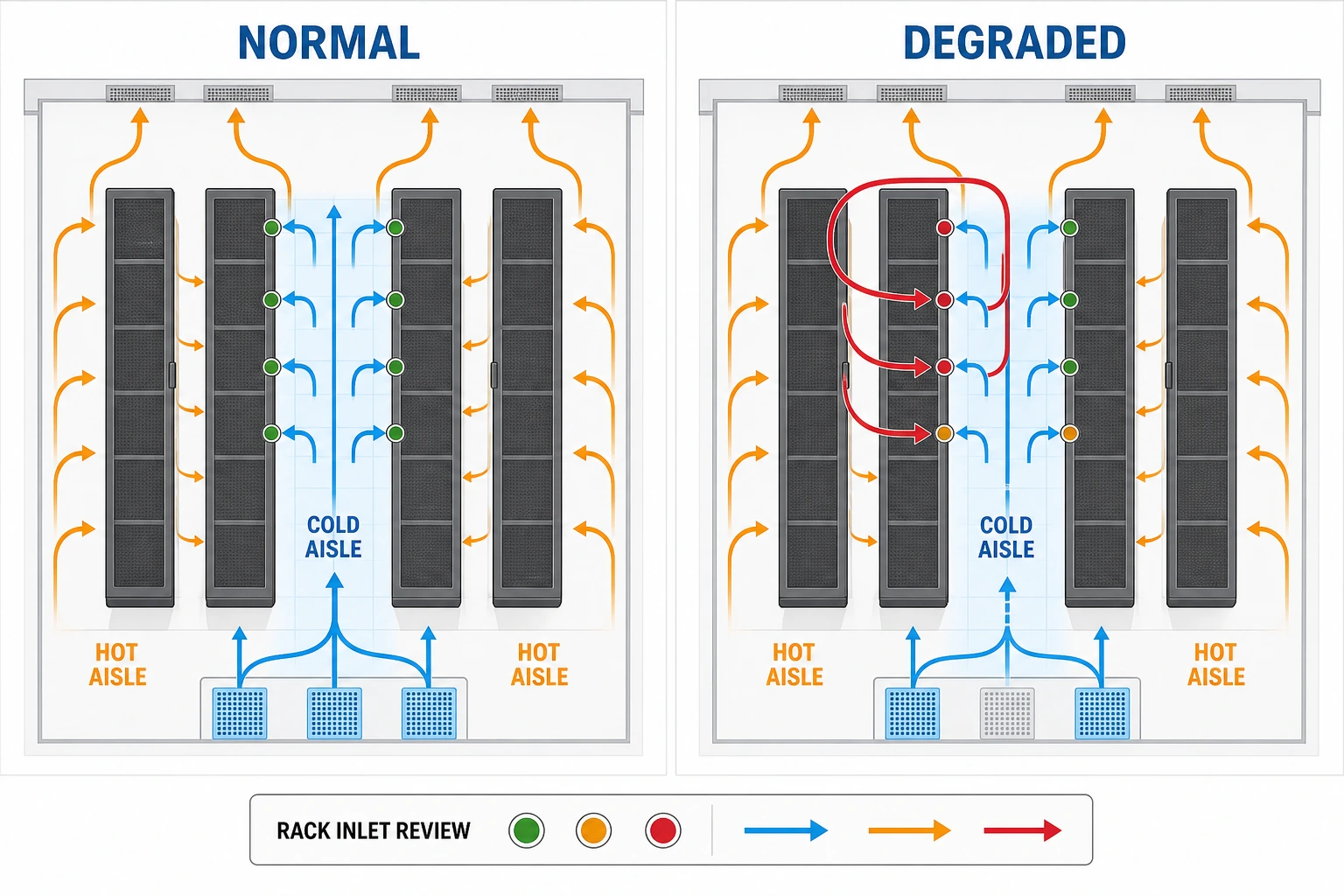
A scenario comparison connects layout and cooling changes with rack-inlet evidence, affected zones, and remaining margin.
A visually convincing thermal field still needs decision metrics. Buyers should agree on metrics before the final comparison.
Useful metrics include:
- rack-inlet temperature by location and height
- remaining thermal margin against the approved equipment or site envelope
- number and location of racks approaching a review threshold
- hot-air recirculation and cool-air bypass patterns
- difference from baseline by rack, row, room, or equipment class
- sensitivity to load distribution, cooling performance, containment, and initial condition
- behavior under normal, maintenance, and selected degraded states
- uncertainty and evidence confidence for the intended decision
For transient changes, the study may also compare rate of temperature rise, time to an agreed threshold, and recovery behavior. These values should retain the scenario conditions and evidence level that support them.
Keep the capacity claim inside the evidence envelope
Capacity is a decision made under stated conditions. A result should identify the room and rack scope, equipment population, load distribution, cooling state, environmental envelope, time horizon, controls, and operational assumptions it covers.
Examples of proportionate conclusions include:
| Evidence | Buyer conclusion |
|---|---|
| Reviewed exploratory model | Candidate A shows stronger relative airflow distribution and thermal margin under the stated representative conditions |
| Benchmarked workflow | The method reproduces the selected reference behavior within the reported checks and supports comparison of the defined alternatives |
| Site-calibrated model | The proposed load and layout can be evaluated against site measurements within the documented calibration range and residual limits |
| Scenario-specific validation | The selected option supports the stated planning decision for the validated variables, locations, and operating states, subject to qualified approval |
Strong capacity language includes the conditions beside the result. This makes the analysis reusable when loads, equipment, controls, or layouts change.
The simulation evidence evaluation guide provides a procurement framework for methods, inputs, verification, validation, uncertainty, and handover. The calibration guide explains how measured evidence changes claim confidence.
Review the full operating range
A candidate layout that performs well at one central estimate may become sensitive under a different load distribution, cooling-unit state, leakage condition, or starting temperature. Scenario ensembles help teams understand that range.
Useful variations can include:
- current, near-term, and planned rack loads
- balanced and concentrated load distributions
- expected and conservative equipment airflow demand
- normal and maintenance cooling configurations
- selected degradation in fan, pump, coil, or airflow performance
- intended and degraded containment conditions
- representative environmental and control states
- alternative response or recovery timing
The scenario ensembles and conservative review guide explains how to select a decision case from plausible scenarios. The buyer should be able to see which option remains robust, which variables drive the result, and where additional measurement or engineering work adds the most value.
Connect planning evidence with execution
Capacity decisions move through design, procurement, installation, inspection, commissioning, and operational verification. The digital twin can preserve the link between the approved scenario and the physical change.
A connected workflow can include:
- Frame the decision - define the proposed load, location, operating states, constraints, and approval owner.
- Verify the baseline - align rooms, racks, cooling assets, sensors, loads, operating evidence, and current field condition.
- Prepare alternatives - create controlled rack, load, cooling, containment, and layout scenarios.
- Compare evidence - review thermal margin, affected zones, sensitivity, residuals, uncertainty, and confidence.
- Approve the option - record the selected scenario, assumptions, acceptance criteria, and engineering review.
- Execute the change - route field checks and approved work through Inspector or the existing maintenance workflow.
- Verify the outcome - compare post-change measurements and field evidence with the approved baseline and scenario.
This chain gives operations teams a durable record of what was planned, what was installed, and how the outcome was confirmed.
Buyer checklist
Business and capacity decision
- Is the proposed workload, rack population, location, and timing defined?
- Which electrical, cooling, space, redundancy, and operational constraints apply?
- What rework, service risk, or schedule consequence is the study intended to reduce?
Data readiness
- Are rack identity, geometry, equipment population, airflow direction, and current load available?
- Are cooling equipment, distribution paths, controls, containment, and active state represented?
- Are rack-inlet and supporting measurements spatially mapped and quality checked?
- Can current, proposed, and conservative load assumptions be traced to an owner?
Scenario and evidence quality
- Does each option change a controlled set of variables?
- Are result scales, thresholds, and operating conditions consistent across the comparison?
- Are benchmark, calibration, residual, validation, uncertainty, and sensitivity records available?
- Does the claimed confidence match the evidence level and intended decision?
Approval and handover
- Is a qualified engineer responsible for the conclusion?
- Are assumptions, limits, and revalidation triggers attached to the approved option?
- Can installation and inspection work be linked to the affected assets and locations?
- Is post-change measurement and verification included in the plan?
Scope a capacity pilot
A focused pilot can start with one room, pod, or aisle and one real capacity decision. The team verifies the baseline, selects two or three candidate alternatives, defines required operating states, and agrees on the rack-level metrics and evidence confidence needed for approval.
Pilot success criteria can include:
- a current spatial and asset baseline accepted by facility and information technology owners
- traceable current and proposed load assumptions
- reproducible scenario definitions and controlled comparisons
- rack-level thermal margin and affected-zone views
- visible evidence confidence, sensitivity, and limitations
- one approved capacity, measurement, containment, or layout decision
- a handover package that supports execution and post-change verification
Explore Data Center Operations for the broader workflow across assets, energy, environmental telemetry, inspections, maintenance, and project-enabled thermal analysis. Read Cooling-Failure Scenario Analysis when the capacity decision also needs resilience review.
For the rack-level measurement and limit basis behind the comparison, read Rack-Inlet Temperature and Thermal Margin.
Public references
The ASHRAE Data Centers and Telecommunications Facilities handbook chapter discusses increasing rack heat loads, equipment inlet conditions, airflow requirements, and facility cooling considerations.
ASHRAE's AI Data Center Energy Performance Framework site-planning guidance highlights workload requirements, increased rack densities, power distribution, and advanced cooling strategies as planning considerations.
The United States Department of Energy Best Practices Guide for Energy-Efficient Data Center Design covers information technology systems, environmental conditions, air management, cooling systems, and measurement practices relevant to capacity planning.